
 E-Paper



Contractual workers’ stir leaves Ludhiana commuters in lurch
Hundreds of commuters were left stranded and forced to shell out extra money for private transport as the first day of the three-day strike called by contractual employees of PUNBUS and the Punjab Road Transport Corporation (PRTC) disrupted bus services across Ludhiana on Monday

 Prefer HTon Google


Hundreds of commuters were left stranded and forced to shell out extra money for private transport as the first day of the three-day strike called by contractual employees of PUNBUS and the Punjab Road Transport Corporation (PRTC) disrupted bus services across Ludhiana on Monday. Long queues, overcrowded buses and prolonged waiting times were witnessed at the ISBT.
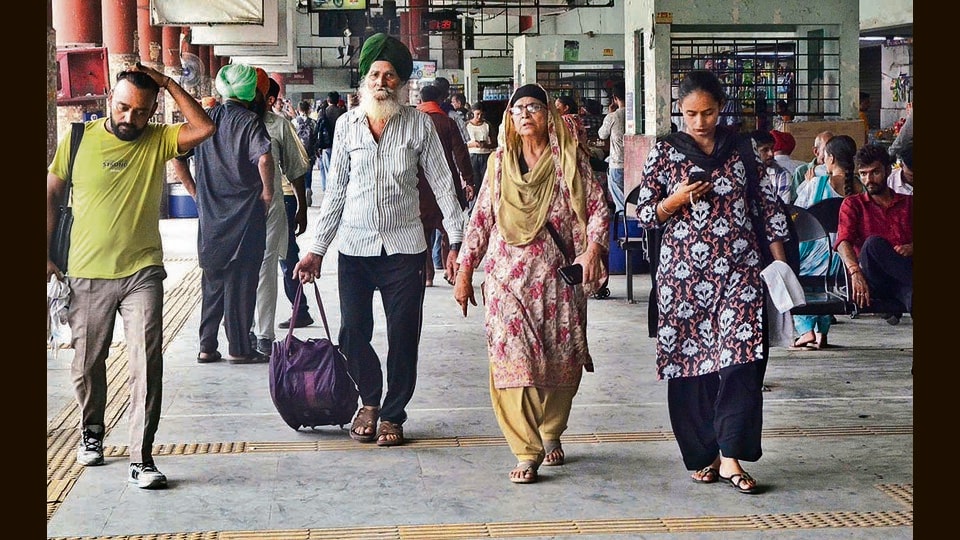
The strike, called from August 3 to August 5 by employees’ unions, is aimed at pressing the state government to regularise contractual workers, implement the Punjab and Haryana high court’s directions on equal pay for equal work, and withdraw a criminal case registered against a PRTC employee from the Sangrur depot during a protest against the kilometre scheme in November.
Although union representatives held talks with transport minister Harpal Singh Cheema in Chandigarh on Monday, the agitation continued after the government allegedly failed to provide a written assurance on their demands.
According to Sukhwinder Singh, vice-president of the PRTC employees’ union, around 150 PRTC buses and 80 PUNBUS buses normally operate from the Ludhiana depot. “The meeting with the transport minister lasted nearly two to three hours, during which the minister verbally assured the union that its concerns would be addressed, but no written assurance was given. The agitation will continue unless we get commitment on paper,” Singh said.
The employees’ body has also alleged that despite nearly 70 meetings with the state government over the past four years, no concrete decision has been taken on its long-pending demands. It further claimed that a committee constituted to examine the regularisation of contractual employees has yet to arrive at any conclusion.
The union alleged that the state transport fleet has steadily shrunk as condemned buses have not been replaced, even as private buses operating under the kilometre scheme continue to expand, weakening the public transport system.
Warning that the agitation could intensify if the government does not issue a written assurance, the union announced plans to stage a protest at the Mohali bus stand and later gherao the chief minister’s residence. Singh claimed that nearly 17,000 to 18,000 employees are associated with PUNBUS and PRTC across Punjab.
Difficulties faced by commuters
“I came to the bus stand at 8 am to catch a bus to Moga for work, but there was no certainty about when a bus would arrive. Now I have to pay ₹350 for a private vehicle, almost three times my usual fare. A day’s wage is already difficult to earn, and now I have to spend a large part of it just on travel,” said Ramesh Kumar.
Students, too, were among those worst affected as many were forced to opt for private transport after waiting for government buses that either did not arrive or were overcrowded.
“I travel daily from Khanna to Ludhiana using the free government bus service. Today I waited for more than an hour, but every bus that arrived was packed. I eventually boarded a private bus after paying the fare because I couldn’t afford to miss my classes,” said college student Pooja Sharma.
Passengers also complained that the limited number of buses operating during the day were packed beyond capacity, forcing many to travel standing while others continued waiting in the hope of getting a seat.
Punjab Roadways general manager Nawraj Batish said, “The department has implemented a contingency plan to minimise inconvenience to commuters. Nearly 45% of the bus services remained operational. The issue is being discussed at the state level.”


