
 E-Paper



Sanatan stood firm despite foreign attacks, traditions survived: Yogi
Adityanath was in Mathura district on Thursday, where he inaugurated 62 projects worth ₹540 crore and laid the foundation stone for 167 projects worth ₹437 crore. In all, Mathura received projects worth ₹1,051 crore a day ahead of Janmashtami.

 Prefer HTon Google


Chief minister Yogi Adityanath said on Thursday that ‘Sanatan’ had stood firm in the face of attacks by foreign invaders, maintaining its continuity and capacity to rebuild. Places such as Mathura, Ayodhya and Kashi, he said, were the biggest examples of how invaders could destroy temples but could not harm traditions, with festivals continuing despite such attacks.
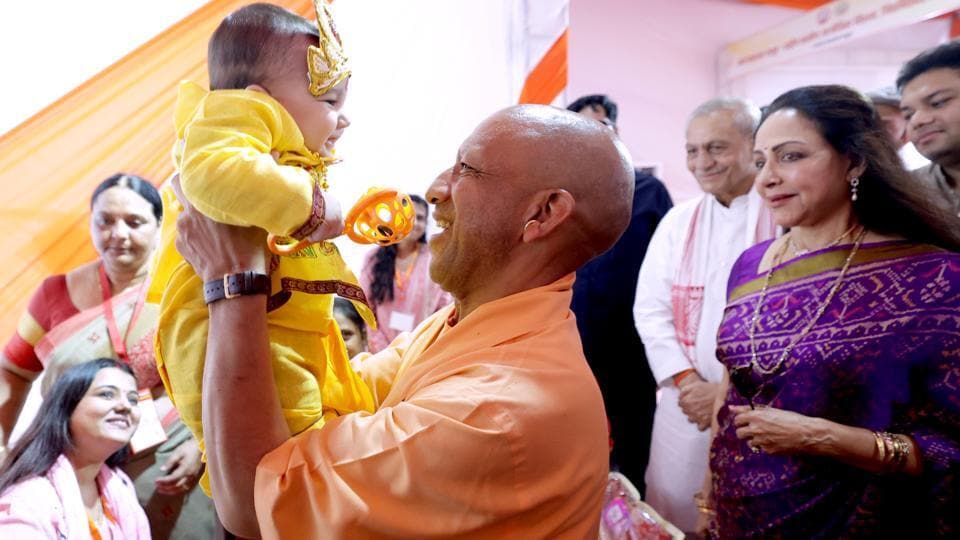
Adityanath was in Mathura district on Thursday, where he inaugurated 62 projects worth ₹540 crore and laid the foundation stone for 167 projects worth ₹437 crore. In all, Mathura received projects worth ₹1,051 crore a day ahead of Janmashtami.
He also distributed financial assistance of ₹72 crore to beneficiaries of various government schemes and inaugurated the Shri Swami Haridas Auditorium, a cultural centre.
He stayed overnight at the guest house of the Veterinary University in Mathura and is scheduled to offer prayers at Sri Krishna Janmabhoomi, on Friday. He will also attend ‘Gau Pujan’.
Addressing a gathering at the newly inaugurated auditorium, Adityanath said the history of the nation was one of struggle, rebuilding and continuity of ‘Sanatan’.
“Mathura is the biggest example. The Keshav Dev temple here faced attacks by foreign invaders who destroyed temples but could not erase the memories of Krishna or Radha. They could not stop festivals organised here in Mathura, including Holi, and devotees continued with the tradition of parikrama.
“This is the power of ‘Sanatan’ and ‘bhakti’. Saints like Swami Haridas created a wave in favour of ‘Sanatan’ through their music,” the chief minister said.
“The same happened in Kashi, where Mughal ruler Aurangzeb destroyed a temple but could not destroy its traditions or end its culture. Lokmata Ahilyabai Holkar played an important role in the renovation of the Kashi temple, and today a grand Kashi Vishwanath Dham stands tall in Kashi,” he added.
“In Ayodhya, Babur destroyed the Ram temple in 1528 and created a structure of slavery, but could not stop the celebration of Ram Navami or the tradition of parikrama. Traditions continued and ‘Sanatan’ stood strong during testing times. The outcome is the grand Ram Temple in Ayodhya, reminding us of the ancient period,” the Chief Minister said.
“We need to understand the teachings of saints and our folk music. We have to read about revolutionaries and historical figures such as Maharaja Suheldev, Lokmata Ahilyabai Holkar, Rani Lakshmibai, Maharana Pratap, Chhatrapati Shivaji, Guru Gobind Singh and Jagadguru Adi Shankaracharya, who carried forward our rich traditions despite the odds,” he said.
“For long, development was seen as being related to roads, electricity, water supply, industries and buildings, while ‘virasat’ (heritage) was insulted in the name of ‘vikas’ (development). The memories of our heroes were erased. Foreign invaders demolished the pride of our heritage and the British continued with this policy. The previous regime in the country crossed all limits,” Adityanath said.
“Now, sites in Mathura are shining with development. But could anyone have thought about such development before 2017? It was a difficult time for this region. In June 2016, the Jawahar Bagh incident took place in Mathura, in which 29 people, including two police officers, were killed as anarchy prevailed. How can one talk of development or preserving heritage in such a scenario of anarchy and lawlessness?” the chief minister said.
“In 2025, 156 crore tourists came to Uttar Pradesh, and this is changing the state through better connectivity and infrastructure. We need to promote tourism, attract more investment and ensure the growth of all sections of society. But for this, we need good law and order, which is the prime requirement for better tourism, investment and overall progress,” the chief minister said.
“The state used to witness riots in Mathura, Meerut, Aligarh, Muzaffarnagar and Lucknow before 2017. Now, UP is free from curfews and riots, while rioters were welcomed at the chief minister’s residence before 2017.
“This year, five crore Kanwariyas travelled on the route from Ghaziabad to Haridwar during Sawan. As many as 66 crore devotees attended the Mahakumbh and made the whole world aware of our capability to use technology to organise such grand events,” the chief minister said.


