
 E-Paper



Two-day anti-narcotics conference: Inside India’s plan to go drug-free by 2047
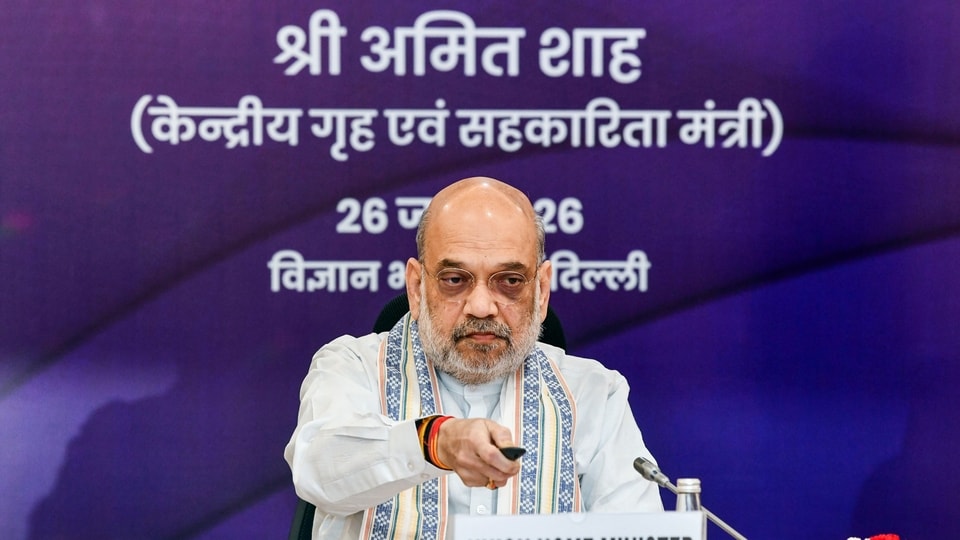
Union home minister Amit Shah opens the two-day conference reviewing the 2026-2029 Vision Document, a step towards a drug-free India by 2047.

 Prefer HTon Google


Senior anti-narcotics police officers from every state and Union territory converge on New Delhi on Tuesday for a two-day conference inaugurated by home minister Amit Shah. The meeting is a progress check on a three-year national plan against drug trafficking, and a step towards a much long-term goal: a drug-free India by 2047.
The plan
On June 26 this year, Shah launched the Vision Document 2026-2029, a national plan with measurable targets covering policing, prevention and rehabilitation. The Narcotics Control Bureau (NCB), India’s nodal anti-drug agency, finalised the document after consulting other agencies and presenting it to Shah twice before it was approved and circulated.
This week’s conference reviews progress on the targets assigned to state and UT anti-narcotics task forces (ANTFs), alongside initiatives other stakeholders have taken up against trafficking and substance abuse. In effect, the meeting will be a stock-take of what has been achieved since the plan’s launch and what remains before the 2029 deadline.
Central to the enforcement push are ANTFs, dedicated units set up in every state and UT police force in December 2021 that functioning under the police chief and are headed by an officer of at least superintendent of police rank.
Before 2021, anti-drug units existed in each department but worked independently, without a shared platform or common targets. Similar units are now being raised within Central Armed Police Forces; and the Central Industrial Security Force (CISF), which guards airports and ports identified as major transit points, will launch its own anti-drugs unit in the coming months to intercept narcotics in transit.
What the two days will cover
Organised by the NCB under the theme ‘United Resolve, Shared Responsibility’, the discussions will be built around four pillars of the Vision Document. These are enforcement, intelligence and operations; control of precursors and synthetic drugs; demand and harm reduction; and capacity building and coordination.
Eight technical sessions will be conducted under these pillars, spanning the plan’s institutional mechanism, dismantling trafficking networks and cartels, demand reduction and rehabilitation, strengthening enforcement, precursor and synthetic-drug control, destruction of illicit cultivation and alternate cropping, and darknet and crypto investigations.
Much of the work is about matching targets to methods. Every state agency, for instance, has been set a target of taking down 100 major drug players. At the conference, officers will be able to compare notes on how best to get there.
Also read: NCB busts twin Pak heroin routes into J&K via Uri, Punjab
The scale of the problem
The NCB’s 2025-26 annual report draws on India’s Magnitude of Substance Use Survey (2019) to estimate about 31 million current cannabis users and 23 million opioid users nationally, placing the country among the world’s largest opioid-use populations.
In 2025, enforcement agencies arrested 183,675 people, filed 148,063 cases, and seized 1,240.9 tonnes of drugs, the highest annual haul on record. Cannabis, including marijuana, hashish and hashish oil, made up 51% of that seizure.
The drugs seized last year were valued at ₹18,227 crore. Between 2021 and 2025, the cumulative figure was ₹108,092 crore.
The Centre has also identified 25 fugitives abroad who are major players in India’s drug trade, and bringing them back is itself a measurable target under the plan. Virender Basoya, the alleged kingpin behind India’s biggest cocaine bust — 1,289kg seized in October 2024 — was deported from the UAE last month. Before him, Salim Dola, an alleged aide of underworld figure Dawood Ibrahim, was deported from Turkiye.
The US last week identified India, China and Pakistan among 23 major drug transit and illicit drug producing countries, with President Donald Trump urging the governments to address the issue.
But, in a Presidential Determination to the US Congress, Trump also made it clear that the countries named on the list did not necessarily reflect the government’s efforts to crack down on such illegal operations. The document said countries were placed on the list due to a combination of geographic, commercial, and economic factors that allow drugs or precursor chemicals to transit or be produced, even if its government had engaged in robust and diligent narcotics control and law enforcement measures.
“I welcome Prime Minister Modi and the Government of India’s efforts to address illicit opium poppy cultivation and bolster supply chain integrity. I look forward to continued cooperation through the United States-India Drug Policy Framework,” Trump said in the Presidential Determination.
Why India is exposed
India’s geography places it at the meeting point of two of the world’s major drug-producing regions, the NCB report noted, making the country a transit hub for both natural and synthetic narcotics.
Four corridors bring drugs in: the Golden Crescent (Afghanistan-Pakistan-Iran), through which heroin, opium and hashish enter via Punjab, Rajasthan and Gujarat; the Golden Triangle (Myanmar), which supplies methamphetamine, heroin and Yaba tablets to Manipur and Mizoram and remains the country’s principal source of methamphetamine entering via the Northeast; the Indian Ocean maritime route, used for cocaine; and the Balkan route (Afghanistan-Iran-Turkey), through which heroin and methamphetamine arrive by air from West Asia.
The Golden Triangle has grown more significant since the Taliban’s 2022 poppy ban, after which Myanmar overtook Afghanistan as the world’s largest illicit opium producer, driven by a decade-high production surge amid economic collapse, civil war and the aftermath of the 2021 military takeover. In response, the Indian government has begun fencing the India-Myanmar border.
On the western front, anti-drone guns have been deployed to shoot down drones carrying heroin from Pakistan, a tactic that has become common across border villages in Punjab, Rajasthan and Jammu.
The Afghanistan-Pakistan-Iran corridor remains, in the NCB’s assessment, a primary opiate-trafficking complex, still fed by pre-ban Taliban stockpiles estimated at 13,200 tonnes.
As the NCB report put it: “India occupies a position of exceptional strategic consequence within the global narcotics ecosystem. Its role is multidimensional: a transit corridor for cross-border drug flows, a supplier of precursor chemicals essential to synthetic drug production, and an increasingly important consumption market shaped by shifting socio-economic and demographic dynamics.”
What government hopes to achieve
The aim of the conference is to take stock of progress under the 2026-29 Vision Document, flag the obstacles states are running into, and work out how enforcement can be strengthened before the 2029 deadline.
“The deliberations will enable participating states, departments and agencies to move forward with renewed commitment towards effectively combating drug trafficking across the country over the next three years,” a government spokesperson said, adding: “The discussions are expected to generate actionable strategies to further strengthen drug law enforcement and keep the youth of the country away from drugs. This national event will also seek to further deepen a future-ready partnership between NCB and State/UT ANTFs to combat drug abuse and realise the vision of a Drug-Free India.”


