
 E-Paper



Six winners of $100,000 Infosys Prize 2025 announced
Infosys recognises the achievements of contemporary researchers and scientists across six categories


The Infosys Science Foundation on Wednesday announced the Infosys Prize 2025 in six categories. The award, which is given every year, recognises the achievements of contemporary researchers and scientists across six categories.
Karthish Manthiram, professor of chemical engineering and chemistry at Caltech, bagged the prize in Physical Sciences for his work on creating sustainable chemical processes using renewable electricity, thereby fuelling cleaner and more efficient industries. Sabyasachi Mukherjee, associate professor at the Tata Institute of Fundamental Research, Mumbai, emerged winner in Mathematical Sciences for his research that links different areas of mathematics, such as group dynamics and complex analysis, to study patterns that emerge from simple rules. “Prof. Mukherjee’s research reflects both the creativity and precision at the heart of mathematical thought,” read a post on X by Infosys Prize.
While Dr. Anjana Badrinarayanan, associate professor at the National Centre for Biological Sciences, Bengaluru, won in the Life Sciences category for her research that helps in understand the essential processes that keep living systems stable and healthy, Sushant Sachdeva, associate professor at the University of Toronto, will receive the prize in Engineering & Computer Science category for his work on algorithms and optimisation that “strengthens the foundations of computing that support communication, healthcare, and transport systems around the world”.
Associate professor at the University of Chicago Andrew Ollett, who won the Humanities and Social Sciences award, is a leading scholar of Prakrit languages and Indian intellectual history, and studies how languages influence culture, literature, and ideas across centuries.
The Economics award went to Nikhil Agarwal, Paul A. Samuelson Professor of Economics at MIT whose work on market design has “helped improve systems that match people to opportunities, including school choice, medical residencies, and kidney exchanges”. Through his research, said the Infosys Foundation, Agarwal is making markets more transparent and fair for everyone involved.
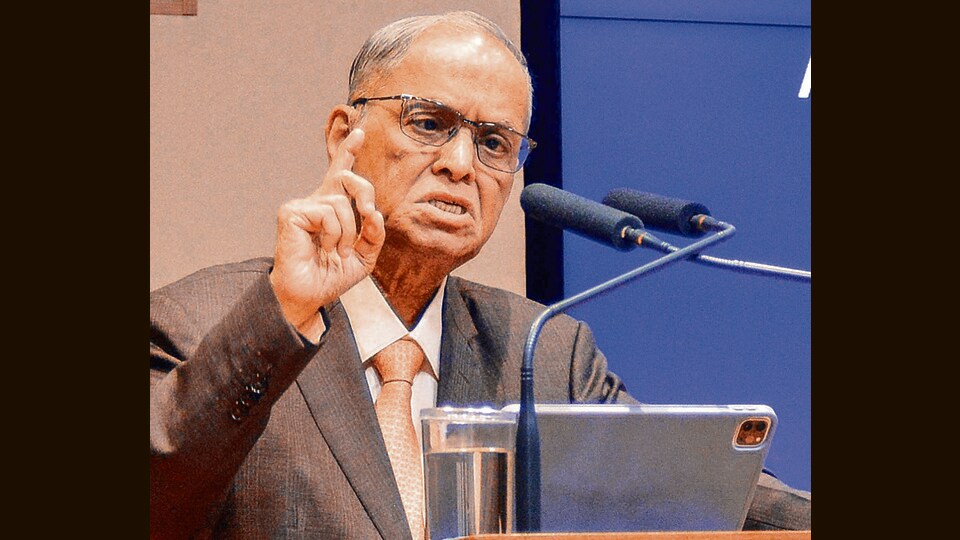
“Research is humanity’s noblest collective enterprise. It demands courage, persistence, and imagination. It bridges science and society, reason and values, and ethics and dignity,” said NR Narayana Murthy, trustee - Infosys Science Foundation and founder, Infosys Limited, during his keynote address at the press conference to announce the winners of InfosysPrize2025.
Referring to Jawaharlal Nehru’s comment that “it is science alone that can solve the problems of hunger and poverty, of superstition, and deadening customs and traditions”, Murthy, said research is the only means we have to make India a better nation, and this world a better world.
“This is the only way that we can fulfil the dreams of our founding fathers. The founding fathers sacrificed their lives to create an India where the poorest child in the remotest village would have good access to nutrition, healthcare, shelter, education and an opportunity to lead a fulfilling life,” he added.
Each winner will be awarded a gold medal, a citation and $ 100,000 (or its equivalent in Rupees).


