
 E-Paper



OPPO K14 Plus: Built to perform today, made to last for years
The OPPO K14 Plus promises longevity with an 8000 mAh battery, delivering extensive usage times and retaining 80% capacity over 1,800 charge cycles.

 Prefer HTon Google


Most of us know the feeling. The phone you bought two or three years ago was quick once. Now apps take a moment to open, the battery is gone by evening, and the charger goes everywhere with you. Your smartphone is starting to lag.
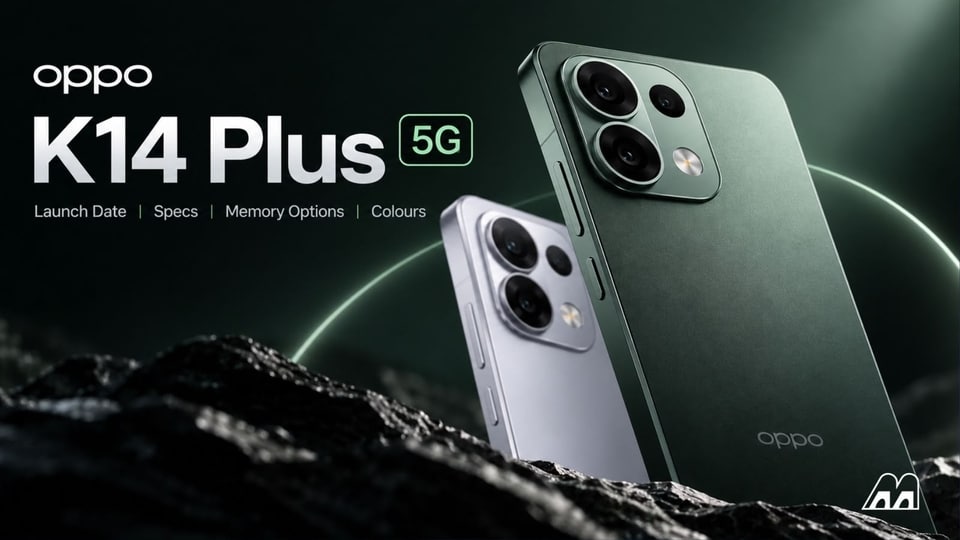
Buying a new phone is a household decision, not a quick impulse. You watch reviews, compare pages and look for the option that will still feel good long after the box is gone. The OPPO K14 Plus is built around exactly this thinking. It promises that it’s “Powered to Perform, Built to Last."
A battery that outlasts the phone it replaces
If you are tired of carrying a power bank, the battery is likely your top concern. The OPPO K14 Plus comes with a massive 8000 mAh battery. In OPPO Lab tests (Wi-Fi, 25°C), it delivered:
· 20.97 hours of YouTube playback
· 30.33 hours of WhatsApp voice calls
· 15.03 hours of Instagram Reels
· 14.39 hours of Maps navigation
· 8.93 hours of 4K30 video recording
Typical mixed use lasts about 2.95 days. For a commuter, that can mean navigation on the way to work, calls through the day, music and reels in the evening, all before you need to think about a charger.
The bigger promise is longevity. The battery is engineered to retain 80 per cent or more of its capacity after 1,800 full charge cycles. At one full charge a day, that is roughly six years. Battery wear is one reason older phones feel tired, so this is the spec that speaks most directly to buying a phone for the long term.
Charging that fits into your day
The OPPO K14 Plus supports 45W SUPERVOOC charging. In OPPO’s tests, starting from 1% with the screen off, the phone reaches 8% in 5 minutes, 14% in 10 minutes, 20% in 15 minutes and 36% in 30 minutes. A full charge takes about 101 minutes. So, when you are running late, five minutes on the charger while you get ready can give you around 1.54 hours of WhatsApp video calling or about 0.77 hours of Instagram, according to OPPO Lab figures.
There are two more thoughtful touches. Bypass charging sends power directly to the phone while it is in heavy use, which reduces battery cycling and heat. And 10W reverse wired output lets you charge earbuds, another phone or an accessory from the K14 Plus in a pinch.
6 years of smoothness protection
The “Built to Last” promise goes beyond the battery. The OPPO K14 Plus comes with 6-Year Smoothness Protection, which OPPO Lab tested using ageing technology. Several software layers support it. The Luminous Rendering Engine keeps transitions smooth across the lock screen, home screen and apps. The Trinity Engine with Parallel Loading predicts your habits and preloads content, so pages appear together rather than with blank loading states. The Adaptive Scheduling Architecture manages memory in the background. On OPPO’s internal 4 GB test unit, it freed 388 MB at start-up and 1,413 MB dynamically, for around 15% overall smoothness gain.
OPPO also plans a Smoothness Boost update roughly every six months through the upgrade lifecycle, and Extended Use Care 2.0 learns your habits to clean up the phone and show a smoothness report.
The physical build matches. The phone carries IP69K, IP68 and IP66 ratings, tested by SGS to ISO 20653:2023. IP68 covers immersion to 1.5 metres for 30 minutes, and IP66 covers powerful water jets. In everyday life, that means a wash under the tap after a muddy trip, a splash in the rain or an accidental dip is less of a worry.
The frame and mainboard cover use AM04 aerospace-grade aluminium, which passed 1,000 bend cycles. It adds strength and also helps spread heat. Extra cushioning, reinforced corners and a front glass that is 0.05mm thicker than the previous generation add to protection against everyday knocks.
A screen you notice from the first scroll
The most visible upgrade on the OPPO K14 Plus is its display. It has a 1.5K AMOLED panel with a resolution of 1272×2772 and 450 pixels per inch. In everyday terms, the text looks sharp, photos look detailed and colours look rich, thanks to 10-bit support for 1.07 billion colours.
The screen supports 60, 90, 120 and 144 Hz refresh rates. At 144 Hz, scrolling through a long WhatsApp chat, a news feed or a shopping page looks noticeably fluid. The phone also steps down to a lower refresh rate when the content doesn’t need 144 Hz, to help the battery.
Brightness matters for those who travel or work outdoors. The panel reaches 3,600 nits peak brightness, but that figure applies only to small areas of the screen. The number that matters for reading in daylight is 1,800 nits. Checking a map at a busy crossing or a train ticket at a sunny platform becomes easier on this model.
Touch response is quick too. Touch sampling is 120 Hz by default and goes up to 240 Hz. The display also uses 2160 Hz high-frequency PWM dimming at low brightness, a feature aimed at people who find screens tiring to look at during late-night use.
Speed that stays steady beyond day one
On the inside is the Dimensity 7360 MAX chipset, built on a 4nm process. That process keeps power use and heat low. OPPO reports a score of over 1 million on AnTuTu, but the bigger story is consistency.
Think of a working day. You attend a long video call, switch to email, open a spreadsheet and reply on WhatsApp. Phones often slow down as they warm up. The OPPO K14 Plus is designed to avoid this with a 5000 mm² Glacier Vapour Chamber, backed by 19,989 mm² of graphite spread. The chamber’s job is to slow the rise in temperature during long recordings, extended video calls or outdoor livestreams, so the phone keeps performing after an hour, not just in the first few minutes.
The memory setup helps as well as apps reopen faster and switching between them feels easier, even when many are running. The phone comes in 6GB+128GB, 8GB+128GB and 8GB+256GB options, with LPDDR4X RAM and UFS 3.1 storage. RAM can be expanded by up to 16GB.
A camera for moments you can’t repeat
The OPPO K14 Plus focuses on dependable everyday photography. Its 50MP main camera has a 1/2-inch sensor and Optical Image Stabilisation (OIS). Sensor size and OIS make a practical difference. A larger sensor gathers more light, and OIS reduces the shake that spoils photos and videos.
Picture a family function in a dim banquet hall, or a street food stall at night. Turbo RAW multi-frame processing works on dynamic range and highlights, while AI Night Mode with the Raw Super Night algorithm helps bring out clarity in low light.
Family photos also involve different skin tones under mixed lighting. The OPPO K14 Plus recognises white, black, yellow and brown skin tones and corrects each separately, rather than applying one setting to everyone. That helps in group shots.
For videos, the rear camera records up to 4K at 30fps. You can shoot slow motion at 1080p 120fps and 720p 240fps, and use dual-view recording to capture the front and rear cameras in one frame. That is handy when you want to film a child’s birthday surprise and your own reaction together.
Selfie takers get a 16MP Sony IMX480 front camera. The screen can act as a soft light for low-light selfies. AI Portrait Glow offers natural, flash, studio and rim lighting looks. AI Popout 2.0 now covers objects and architecture as well, and AI Remix Collage helps you put photos together.
There is one more useful trick. The phone can shoot underwater, bare, in static freshwater up to 1.5 metres for up to 30 minutes. It has its own underwater colour profile and an auto-drainage routine when you leave the water. A pool day or a monsoon outing suddenly becomes easier to capture.
Small details you feel fifty
The bezels are slim measuring 1.66 mm at the top, 1.65 mm on the sides and 1.90 mm at the bottom, giving a 93.6% screen-to-body ratio. The nearly even borders give the phone a more premium look in the hand.
The fingerprint sensor sits inside the display. It is a small convenience you use dozens of times a day, and it is easy to overlook until it is missing.
The bottom line
The OPPO K14 Plus brings together a 1.5K AMOLED 144Hz display, a chipset designed for steady performance, a 50MP OIS camera with 4K video, a 8000 mAh battery with 1,800-cycle life, 6-Year Smoothness Protection and IP69K protection. Together, they suit a buyer who wants a smart upgrade that will remain reliable and enjoyable for years, not just a phone that looks good on a spec sheet.
For those searching for the best smartphone under ₹30,000, it is a strong model to shortlist.
Note to the Reader: This article has been produced on behalf of the brand by HT Brand Studio and does not have journalistic/editorial involvement of Hindustan Times.


