
 E-Paper





Saloni Bhatia is a journalist with over 15 years of experience in reporting and storytelling, with a strong focus on the Delhi government and political developments in the Capital. Over the years, she has closely tracked policy decisions, governance issues, and political shifts. She started off as an entertainment journalist but then moved to covering beats like crime and education. Her experience on the crime beat helped her develop an eye for detail and accuracy, while education reporting allowed her to explore policy impact on students, teachers and institutions. Outside the newsroom, she enjoys reading both fiction and non-fiction. She also has a keen interest in watching Bollywood films.
CAQM sets 15-20% pollution reduction target for Delhi-NCR in 2027, seeks district-wise action plans
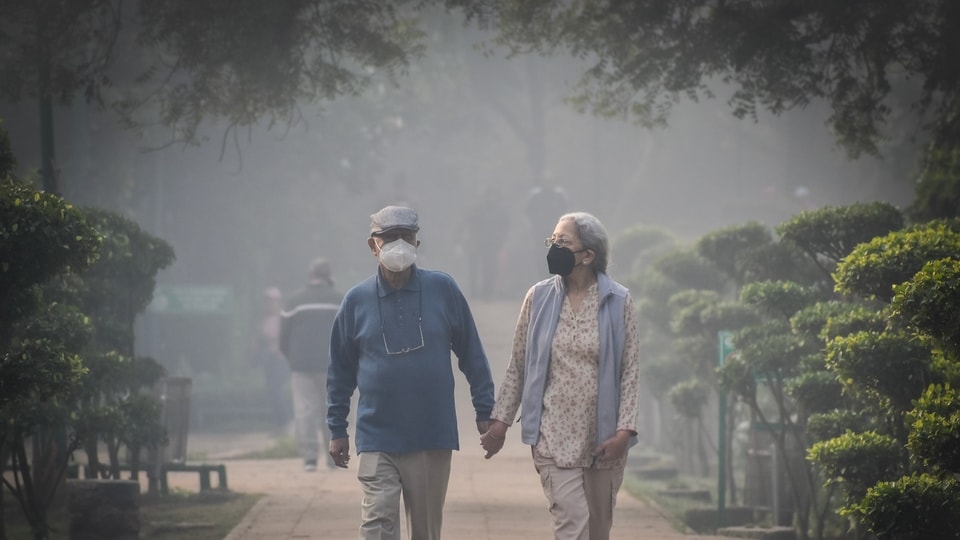
The weather conditions in winter worsen the air pollution impact in the Capital, with stubble burning in neighbouring states adding to the burden.
Updated on: Nov 22, 2026, 08:48:07 IST


Share via
Copy link
The Commission for Air Quality Management (CAQM) has told Delhi and NCR states to cut annual average air pollution by 15-20% in 2027 from 2026 levels. For the first time, it has asked for action plans at the district level, with an officer listed by name for carrying out and monitoring every measure.
The commission has not clarified in the statement how a district’s pollution will be measured, how it will separate the effect of weather from the effect of the measures, or what happens to an officer whose district misses its target.
In a letter to the governments of Delhi and NCR states on November 20, CAQM asked for district-level plans in addition to the existing state and municipal plans. The plans must set measurable targets, timelines and monitoring parameters for vehicular emissions, road dust, industrial pollution, construction and demolition, municipal waste, crop residue burning, diesel generator sets, crematoria and other local sources.
Also read: Delhi air quality remains poor at AQI 278 as calm winds hamper pollutant dispersal
States asked to submit plans by December 5
States must name, for every measure, the department or agency responsible, along with the name, designation and contact details of the officer in charge of carrying it out and monitoring it.
The commission has set a minimum target of a 15% cut in annual average AQI, PM2.5 and PM10 levels from 2026, and asked states and agencies to aim for up to 20%. The plans must be submitted through CAQM’s online portal by December 5. The commission said it would send more action points for the plans, and that measures by urban development authorities would go into municipal corporation plans.
A senior Delhi government official said the government expects more clarity on preparing the plan after CAQM holds a meeting with district magistrates on November 23. “The communication was issued on Friday, and we will follow the directions issued by CAQM,” the official said, asking not to be named.
Also read: Report links cloud-seeding to AQI gain in Delhi; but western disturbance may have had a role
The official said district-level plans were more relevant for the other NCR states, because pollution sources are largely similar across Delhi’s districts, including stubble burning, road dust and vehicle emissions.
“However, pollution sources vary across districts in other states. While one district may be grappling with industrial pollution, another may face dust pollution as a major challenge,” the official said.
CAQM said it had regularly reviewed the 2026 plans to monitor implementation and identify gaps. It said the 2027 effort would follow an “airshed approach”, with measures coordinated across administrative boundaries and pollution sources.
Unclear how district-wise pollution reductions will be measured
A district’s annual average depends on how many monitoring stations it has and where they are, and a single station records the air at only one location. CAQM has not said which readings it will use to judge whether a district met its target.
Pollution also moves across district lines. Officers can act only on emissions within their own district, but the target is set on pollution in the air, and those also depend on what blows in from elsewhere. CAQM describes its approach as covering the whole airshed, yet it has fixed accountability district by district. Annual averages also change with wind, rain and how high pollution can mix into the atmosphere, all of which vary from year to year. The commission has not said how it will tell a cut that came from the measures apart from one that came from cleaner weather.
District officials would need to know how much their district emits, and from which sources, to work out how much any measure would cut. The 15% minimum applies to every district whatever its starting level or mix of sources, and CAQM has not said how it arrived at the 15% and 21% figures.
Experts flag need for emission data and public monitoring
Sunil Dahiya, founder and lead analyst at the think tank Envirocatalysts, called the direction a significant step because it is the first time plans will be drawn up at the district level as well as the state and municipal levels. “Every action will need measurable targets, timelines and a named nodal officer. That sets out clearly where each action applies, which sector it covers and who is responsible for it. The focus on cutting emissions at the source is exactly what NCR and the country needs,” he said.
He said the plan would have to work in practice, and district authorities would need up-to-date emission inventories and “the skills and resources to update those inventories every quarter.” He said making the data public would matter just as much: “That means current emission loads, district-wise inventories by sector, and progress towards the 15–20% reduction target. Public data is what will ensure these steps are carried out on the ground.”
Also read: 4th day of ‘poor’ air, Delhi CM says negligence won’t be tolerated
Weather on Saturday
Delhi’s air quality stayed “poor” for a seventh day Saturday, with 24-hour average AQI at 265—five points better than Friday, as per CPCB. Thirteen of 57 monitoring stations reported “very poor” air. Vehicles contributed 33.1% of the pollution, followed by secondary organic aerosols (16.5%) and biomass burning (13.9%). According to AQEWS forecast, Delhi will continue to see “poor” air.
The maximum temperature was 27.6°C on Saturday while minimum was at 12.2°C, according to IMD.
ABOUT THE AUTHOR

Catch every big hit, every wicket with Crickit, a one stop destination for Live Scores, Match Stats, Infographics & much more. Explore now!
Stay updated with all top Cities including, Bengaluru, Delhi, Mumbai and more across India. Stay informed on the latest happenings in World News along with Delhi Election 2025 and Delhi Election Result 2025 Live, New Delhi Election Result Live, Kalkaji Election Result Live at Hindustan Times.
Stay updated with all top Cities including, Bengaluru, Delhi, Mumbai and more across India. Stay informed on the latest happenings in World News along with Delhi Election 2025 and Delhi Election Result 2025 Live, New Delhi Election Result Live, Kalkaji Election Result Live at Hindustan Times.


