
 E-Paper





Nishant Ranjan has been working as a data journalist with Hindustan Times since 2023. In this short period, he has established a niche for creating original datasets and utilising them to produce journalistic work that pushes the boundaries of journalism. The list of datasets and stories done by him include the following: a dataset of all 717 chief ministers India has had since 1952, a dataset of all 3,350 members of India’s council of ministers, a dataset of all 190 deputy chief ministers in India and a dataset of all 279 Supreme Court judges in India (1950-2025). He has also profiled each elected Muslim MLA/MP since 1952. He is a mining engineer by training who decided to pursue a Master's in Development Studies from TISS after working in a coal mine for 10 months. He also worked as a research associate at the Centre for Policy Research, researching local governance in India. He also has a keen interest in analyzing electoral politics and political executives in India.
Yogi vs Akhilesh: Is UP headed for a direct electoral contest?
2027 Assembly elections are set to be a direct contest between Yogi Adityanath and Akhilesh Yadav. This is a big change for UP politics, historically speaking.

On Thursday, Uttar Pradesh chief minister and Bharatiya Janata Party (BJP) leader Yogi Adityanath challenged Samajwadi Party (SP) chief Akhilesh Yadav to contest the upcoming assembly elections against him from Ayodhya. Adityanath throwing the gauntlet at Akhilesh is one of the clearest examples yet that the 2027 state polls will likely be a direct contest between the two leaders.
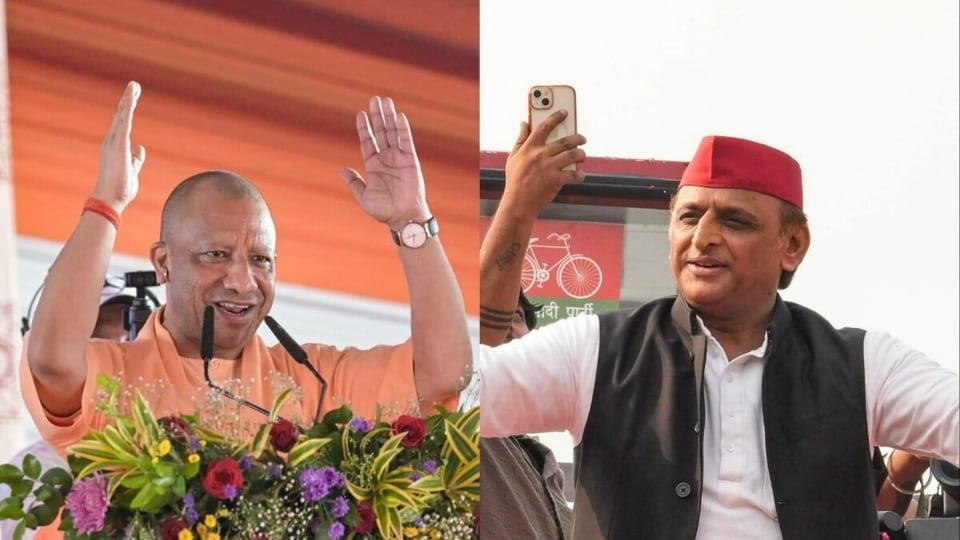
For Uttar Pradesh politics, this would be a significant change, historically speaking. HT has analysed numbers from its in-house databases to make this case.
Uttar Pradesh’s politics has been remarkably stable over the past two decades
When he took the oath as the chief minister for the second time in March 2022, Adityanath created history in India’s largest state. He became the first-ever chief minister in UP’s history to complete a full term in office and get re-elected.
He will now complete a second term in office and is eyeing a third, which would be yet another record. He is also looking to join an elite club of 11 chief ministers (Jyoti Basu, Mamata Banerjee, Raman Singh, Naveen Patnaik, Sheila Dikshit, Tarun Gogoi, Narendra Modi, MG Ramachandran, Bidhan Chandra Roy, Mohanlal Sukhadia and Bimal Prasad Chaliha) out of 526 in India who have assumed office for a third consecutive time after completing two full terms. The analysis includes states and Union Territories with at least 70 assembly seats.
Uttar Pradesh got its first chief minister to complete a full term in office in Mayawati, who served from 2007 to 2012. Akhilesh (2012-2017) and Adityanath (2017-2022 and 2022-2027) have added to this tradition. In the 55 years before 2007, Uttar Pradesh had 33 chief ministers, with their shortest and longest tenures being 19 days and 1,352 days, respectively.
Adityanath is first UP CM to complete a full term while also being an MLA
This is yet another unique feature of Adityanath’s tenure. When he first became chief minister in 2017, he was a Lok Sabha MP from Gorakhpur and decided to become an MLC instead of contesting an assembly election. In 2022, he contested from the Gorakhpur Urban assembly constituency and became an MLA for the first time.
The other two state chief ministers to have completed full terms in office, Mayawati and Akhilesh Yadav, were MLCs when they held the state’s top office. While Mayawati had been a member of all four houses (two houses each in Parliament and the state legislature, respectively), she was a Rajya Sabha MP when she became chief minister for the first time in 1995. Akhilesh became an MLA in the 2022 elections from Karhal, but resigned after winning the Lok Sabha election from Kannauj in 2024.
A historical analysis of HT’s chief minister database of Uttar Pradesh shows that only 23 of the 37 people who took the oath as chief ministers – the list counts the same person as many times as they took the oath – were elected MLAs in the state assembly. Another three – Ram Naresh Yadav (1977), Rajnath Singh (2000) and Mulayam Singh Yadav (2003) – contested by-elections to get elected to the assembly after becoming chief minister.
Five of them became members of the legislative council after becoming chief minister. And four had such short tenures that they demitted office without having been members of either house in the state legislature. Tribhuvan Narayan Singh was a Rajya Sabha MP when he became chief minister in 1970 but had to resign within six months after losing a by-election to the assembly.
There are also two chief ministers in the list who were members of neither of the Houses in the state legislature when they first took office, and who first became MLCs and were then elected to the assembly in a by-election. Chandra Bhanu Gupta and Vishwanath Pratap Singh were two such chief ministers.
While the BJP has yet to make an official announcement, Adityanath is clearly projecting himself as its chief ministerial face for the next election. Given the current state of the Bahujan Samaj Party, which has no elected MLAs in the state, Akhilesh remains Adityanath’s only credible political challenger.


