
 E-Paper



Inside India’s forgotten civic heritage: The neglect of colonial-era buildings
After offices shifted to modern complexes, many colonial-era civic buildings were left underused, and no effort was made to conserve them properly.

 Prefer HTon Google


On the cold morning of February 7, 1951, the 128-foot clock tower in front of Delhi’s Town Hall came crashing down. Three people died. In 1966, the Supreme Court held the municipal corporation liable, reasoning that a tower under its sole control does not collapse unless someone has been careless. The tower is long gone, but the neighbourhood continues to be called Ghantaghar.
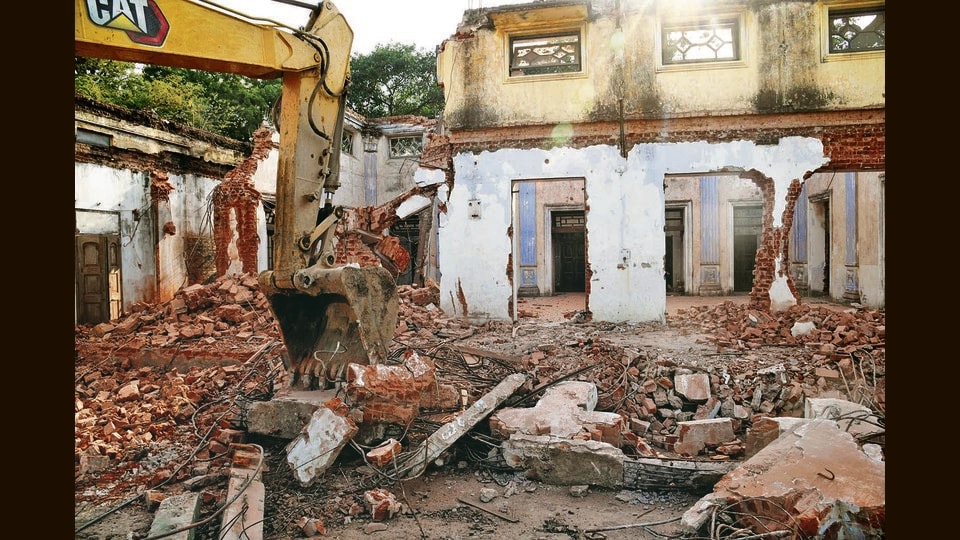
More than 75 years later, on the last night of October this year, after two days of heavy rain, part of the Town Hall itself collapsed. The roof over the entrance porch and two massive beams came down, and the façade, some of the first floor and the porch walls were damaged.
Town Hall, a Victorian building on a Mughal street, is more than 160 years old. The façade, arches and portico belong to the architectural vocabulary of colonial Britain, and the crowded lanes around belong to Shahjahanabad. It began as the Lawrence Institute, also called the Delhi Institute, and was meant to hold a municipal office, a chamber of commerce, a literary society and a museum. Its stated ambition was to ‘improve the local minds’ and encourage interaction between Europeans and Indians. Work began in 1860 and was completed in 1863, in the years after the uprising of 1857. Local residents contributed ₹30,000 toward the cost.
In 1866, the municipality bought it for ₹1,35,457 and moved in. For the next 145 years, it was the seat of Delhi’s municipal government.
The corporation moved to a new 28-storey Civic Centre on Minto Road in 2011-12. The old building emptied, and regular maintenance stopped. Plans for a city museum, a heritage hotel or a cultural centre came and went. The hotel came closest. In June 2021, the erstwhile North Delhi Municipal Corporation invited private operators to lease the complex for 33 years at a minimum of ₹1.92 crore a month.
“We did not receive any bids from interested parties, maybe because of the high reserve price, but the plan to develop it into a Global Heritage with the Delhi government is final. The Delhi Tourism and Transportation Development Corporation (DTTDC) will soon undertake comprehensive conservation of the historic complex,” said an MCD official.
AGK Menon, an architect, urban planner, and former convenor of INTACH’s Delhi chapter who drafted the landmark 2004 Charter for the Conservation of Unprotected Architectural Heritage in India, is not surprised.
“Delhi’s Town Hall is iconic,” Menon says. “As part of INTACH, we tried to conserve it for 20 years. We made detailed proposals. We kept saying the building was going to collapse. People say yes, no, yes, no, and it just doesn’t happen.”
Delhi is not alone. Across India, many colonial-era civic buildings — town halls, collectorates, judicial complexes and old municipal offices from which local administration was once run — face a similar fate. After offices shifted to modern complexes, many of these structures were left under-used and no effort was made to properly conserve them.
Where citizens met the state
The history of these structures goes back to the early colonial period. Fort St George in Madras (now Chennai), established in 1640, and Kolkata’s Writers’ Building, constructed in 1777, were among the early symbols of British administrative power. But it was during the 19th century that municipal buildings, collectorates, courts, libraries and town halls became prominent features of Indian cities.
Designed in styles ranging from Victorian Gothic to Indo-Saracenic, they were meant to project authority and permanence. But their significance extended beyond the administration of the Raj. Over the decades, they became places where Indians encountered the machinery of government, petitioned officials, conducted legal disputes and participated in municipal affairs.
Historian Prashant Kidambi, of the University of Leicester, has examined this relationship through his work on Bombay ( now Mumbai ) in ‘The Making of an Indian Metropolis: Colonial Governance and Public Culture in Bombay, 1890-1920’. His research on petitions shows how Indian residents increasingly used the Bombay Municipal Corporation as a forum for complaints and appeals. Its Gothic headquarters, designed by FW Stevens and completed in 1893, was more than an administrative address: it was a site of engagement between the governed and the government.
Similarly, architectural historian Tania Sengupta, of University College London’s Bartlett School, has explored the colonial cutcherry, or administrative office complex, in provincial Bengal between the 1820s and 1860s. Her research draws attention to the ordinary spaces of everyday governance and the clerks, including munshis from earlier Persianate administrative traditions, who worked within them. It shows how Indian employees and visitors adapted, negotiated and sometimes subverted colonial administrative practices.
These buildings may have been erected under colonial rule, but their subsequent history belongs to the cities and people they served. They witnessed the evolution of local administration, the emergence of municipal institutions and the expansion of public life. When they disappear, cities lose tangible evidence of how their civic institutions developed.
Razed, abandoned, waiting
Patna’s Collectorate shows what that means. It covered about 12 acres by the Ganges, with Dutch and British layers. Its oldest parts were linked to the Dutch East India Company, and the British later made it the seat of district administration. Richard Attenborough’s 1982 Oscar-winning film Gandhi was also shot at the parts of the historic complex with its Dutch Record Room serving as Motihari Jail.
In 2016, the Bihar government proposed pulling it down for a modern administrative building. INTACH, historians and citizens campaigned to save it, and the Dutch ambassador even wrote to then chief minister Nitish Kumar. The Patna high court cleared the way for demolition in September 2020. The Supreme Court ordered status quo that month, but in May 2022, it dismissed INTACH’s appeal, saying not every colonial-era building needs to be preserved. Bulldozers arrived the next day.
Only eight Tuscan pillars from the Dutch-era Record Room were saved. When the new multi-storey Collectorate complex opened in December 2024, those original pillars were installed as a permanent display on a dedicated open plaza facing a green space.
In smaller cities, the loss is quieter. In Kadapa, Andhra Pradesh, K Chinnapa Reddy, convenor of INTACH’s local chapter, has been fighting for two years to rescue the town’s old Collectorate from decay. While authorities have deployed cosmetic interventions—carrying out basic repairs and a fresh coat of paint—the 18th-century stone-oriented monument, built during the era of Thomas Munro and used by nearly 50 district collectors, remains vulnerable. Reddy and local heritage advocates want the historic downtown complex converted into a regional museum and cultural hub, complete with dedicated spaces for local writers, artists, and folk performers. “This building is an integral part of the region’s history,” Reddy says, “and it must be preserved.”
In Pune, the 120-year-old Cantonment Court on MG Road was abandoned in June 2024, though a 2017 structural audit had already called it unsafe. It is now locked and overgrown.
No one’s building to protect
Shikha Jain, a conservation architect and founder-director of DRONAH, a Gurugram-based conservation and heritage research organisation, lists the causes for neglect: departments and staff grow and run out of space, users do not understand the heritage value of their building, and misuse and poor maintenance follow.
Money is part of it. “In our country, most local bodies are running in deficit and lack funds. But it’s really about whether the user understands the heritage value of their building,” she says.
Some do. Jain cites the Brihanmumbai Municipal Corporation, which she says conserves its 19th-century headquarters well. She also gives example of Shimla, where the 1908 Town Hall was restored with Asian Development Bank funding. Many railway and post office buildings are also being conserved well, she says, and the CPWD has carried out conservation on many public buildings and publishes an online manual. What other departments need is training, she says, from bodies such as the ASI, state archaeology departments, and INTACH.
For conservation architect Vikas Dilawari the problem is gap between owner and user. “The owner, usually the PWD, and the user department are often different, and the owner doesn’t always understand what the user needs. So, nobody really takes responsibility for the building as a heritage structure,” he says.
A 2021 NITI Aayog study found that ownership of administrative buildings is scattered across state PWDs, revenue departments and municipalities, and most state town-planning acts have no heritage clause. It adds that most owning bodies need more awareness of what they hold.
“These buildings get a coat of paint on Independence Day or when a dignitary is visiting. That is beautification, not conservation,” Dilawari says.
Keeping them in use
Dilawari’s remedy is use. “Ideally every historic building should be in use, and the use should be adaptive, one that suits the building. If that is done, half the battle is won,” he says. “The use should benefit the town and its residents, not just one department. These were built for public life, and they should continue to serve it.”
The Visakhapatnam Collectorate, inaugurated in 1913, has remained in continuous active use for more than a century and still stands in good condition, showing that with regular maintenance and continued occupation, these structures can continue to serve the city.
Jain, whose organisation prepared the project report for the conversion of Amritsar’s 19th-century Town Hall into the Partition Museum, says adaptive reuse of such buildings, when necessary, poses no major hurdles. “We have enough good examples,” she says. Municipal offices “can serve as very good city museums too,” and showrooms, cafés and restaurants can work, depending on location, she adds.
The biggest obstacle, Jain says, is land value. Where a taller building with more floor area is viable, old buildings that are not listed or protected are often razed. Her team is doing the Heritage Impact Assessment for a planned extension of the Punjab and Haryana High Court in Chandigarh—part of the Capitol Complex, a UNESCO World Heritage Site—to ensure the new building does not affect the old one’s heritage value.
Menon’s case is wider. “Administrative, social, civic history: all of it is part of India’s history,” he says. “That doesn’t mean every brick. There has to be a policy to preserve what is important or iconic. The same logic applies to our civic infrastructure.”
What happened to Delhi’s Town Hall, Menon says, points to something about society. “As a society we are perhaps not interested in history.”
He ties buildings to a city’s memory. “If they go, the urban landscape changes, and so do our memories. We can say Delhi is a thousand years old, as ancient as Rome, because the evidence of that history has been preserved. If you destroy the evidence, where is the history?”
“As a society, we should have pride in our past and a policy to preserve it,” he says.


