
 E-Paper



Javed Akhtar’s take on patriarchy is just plain wrong
Recently, the Renaissance Bengaluru Race Course hotel launched its new restaurant, Chor Bizarre with an evening of poetry featuring Shabana Azmi and Javed Akhtar

 Prefer HTon Google


Recently, the Renaissance Bengaluru Race Course hotel launched its new restaurant, Chor Bizarre with an evening of poetry featuring Shabana Azmi and Javed Akhtar. Over 45 minutes, Javed Saab, as he is called, and Shabana Ma’am, as the audience called her, regaled about a hundred people with poetry and stories. Restauranteur Rohit Khattar who launched Chor Bizarre was there with his team from Delhi. Like Sirio Maccioni used to do at the original Le Cirque, he glided around the Chor Bizarre dining room glad-handing his patrons.
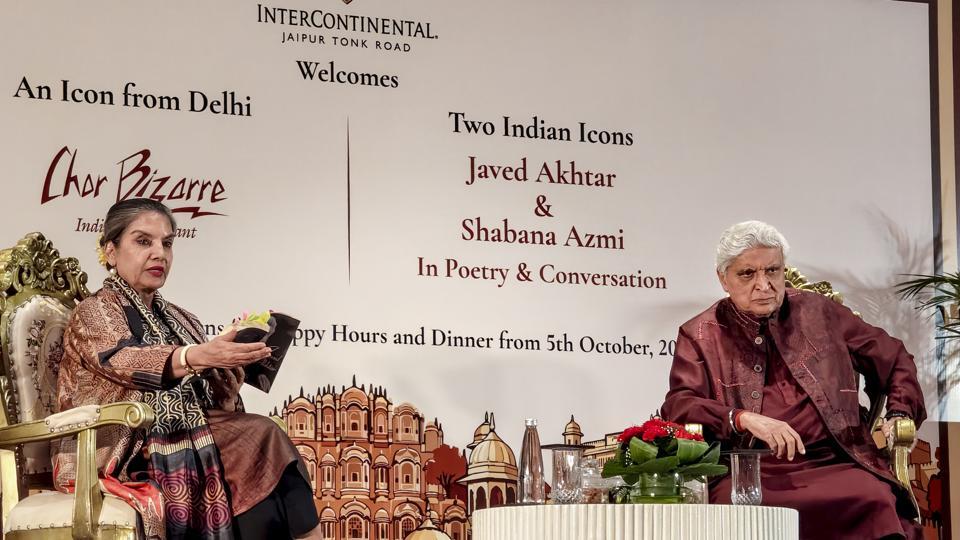
But Javed Akhtar disappointed me, not because of his poetry which was beautiful and moving, but because of his views on patriarchy. When an audience member asked about how women of today could be “audacious” and escape patriarchy, Ms. Azmi spoke about how it was ingrained in the Indian psyche and how all of us, both men and women, needed to introspect, question our choices, and consciously try to move away from this ingrained favouring of the male child. Mr. Akhtar, on the other hand, blamed the mother. He said that it was the mother’s fault for raising a “male chauvinist” by showering him with the love for a “ladla beta.”
Thankfully, the female questioner in the audience did not give up. She asked, “What about the father?” to which Mr Akhtar replied, somewhat flippantly, that the father had no role in raising a child.
Perhaps he belongs to a generation where the father had no role, but to state that patriarchy is the mother’s fault goes back to the tired old cliché in India, where the woman is blamed for all societal problems. Somebody, ideally his enlightened wife, should tell him that it is not cool to blame the mother for India’s patriarchy. But other than the brief interlude which made me pause, the whole evening was about poetry and words.
To get over how upset I was by his comments, friends suggested that I go out for dum-chai and rolls at a corner joint. The word “corner joint” immediately brings to mind Hotel Empire, which is where generations of Bangaloreans have gone to fulfil late-night cravings.
Founded in 1966 on Central Street in the Cantonment area by Abdul Rahim, a migrant from Malaysia with roots in Kerala, Empire gained iconic status in the 1990s. This was when both the IT sector and the pub culture grew in Bangalore. This period saw the emergence of a new urban demographic (young professionals, students, and a burgeoning middle class) with disposable income and a need to fulfil late-night hunger-pangs. The role of the corner joint was to serve predictable comfort food, yes; but also to provide an easy place for hanging around after work, particularly since IT employees operated on time zones aligned to foreign workplaces. So going out to eat at 1 am was not a weekend act but a daily one. Empire astutely positioned itself to cater to this urban ecosystem, both for IT employees and also students. College students would go to Empire with their classmates after a night at pubs, and post-dinner at a “fancy restaurant where the plating was good but the food was empty” as one said.
Empire is not the only late-night joint in Bangalore. Like large global metros, Bangalore has dives, bars, and cheap eateries that are open till late at night.
All of them share a couple of characteristics. One is a menu template of standardized foods, largely non-vegetarian: kebabs, chops, rolls, grills. The second is that corner joints are modest, unpretentious, and often have only a tiny signboard, if that. Siddiqui Kebabs on Coles Road is a prominent aberration with large, well-lit counters. When I pass by it post-midnight, there is still a long line of people standing outside. But there are several street vendors in pretty much every area of Bangalore from Koramangala to Frazer Town to Madiwala that set up their carts at night and serve everything from chicken ghee roast to seekh kadis. Kadi means stick in Kannada and Dakhni Urdu. So seekh kadis are spiced minced meat, beef and chicken roasted straight on the koyla or charcoal grill on skewers, and served directly rather than wrapped in a roti or roll. Vendors typically dust the hot skewers with chat masala and serve them with sliced onions, lime, and mint chutney for around ₹35-65 per stick.
But non-veg does not need to be the only thing. When I asked Prateek Gulati, who is the F&B manager at The Oberoi, Bengaluru, where he and his colleagues went for late-night cravings, he immediately replied, “Khao or Khane Do in Indira Nagar serves just a few dishes like chole bhatura, parathas, and puri-aloo till 1 am, but the taste has made me stop missing my Delhi North Indian food.”


