
 E-Paper



More women in judiciary will make society more fair: President Draupadi Murmu
President Draupadi Murmu on Thursday said that greater participation of women in the judiciary can make society more inclusive and add balance and diversity to judicial decision-making process


President Draupadi Murmu on Thursday said that greater participation of women in the judiciary can make society more inclusive and add balance and diversity to judicial decision-making process.
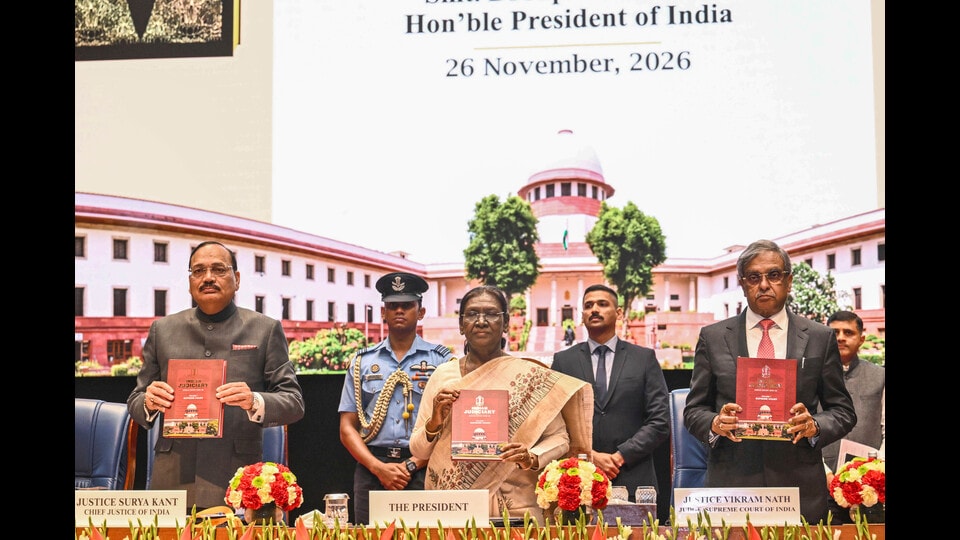
Addressing a gathering of Supreme Court judges, former CJIs, judges, lawyers and law students at the Constitution Day function organised by the Supreme Court here, President Murmu said, “Larger and more active participation of women in the bench and Bar will help make our society more fair, just, equitable and inclusive.”
Emphasising how the role of women can add diversity to the decision-making process, she cited the example of Hansaben Mehta, a former member of the Constituent Assembly that framed our Constitution, who was instrumental in amending Article 1 of the Universal Declaration of Human Rights (UDHR). In 1947-48, when the text of UDHR was drafted, Mehta took part in the deliberations as a delegate from India. The opening Article which said, “All men are born free and equal,” was changed to “All human beings” at Mehta’s instance.
“A woman’s perspective can add to inclusion, diversity and balance to judicial decision-making,” the President said, adding, “Women have made valuable contributions to the jurisprudence in our country. We should encourage greater participation of women as judges and lawyers.”
The President was accompanied by the Chief Justice of India (CJI) Surya Kant and Union Law Minister Arjun Ram Meghwal, the key stakeholders in ensuring the appointment of judges to constitutional courts. She said, “Greater emphasis on inclusivity and merit will further strengthen our judiciary.”
She congratulated the government for making India “Naxal-free” and urged the judiciary to consider the reasons that make innocent villagers become Naxals. “When I see the faces of surrendered people who are Naxals, they look innocent. Those who are inside have made them so. Why were they made Naxals? We need to work on this.”
Highlighting another area of concern, the President said that schools, during her time, allowed students of all strata of society to study, play and interact together. However, today, she stated that this situation has changed, where the elite send their children to good, private schools while a poor child gets to study in a government-run school.
“Children are not poor, only their parents are poor. This mentality of the child that I am poor and so I cannot aspire to study in a good school cannot help a child progress... Children are the future of this country and for the sake of the country’s future, all children must get education on the same terms,” she said.
She also urged the leading advocates in the legal profession to inspire the upcoming, young lawyers by presenting shining examples of how excellence can be blended with empathy and competence with compassion.
Mixing Hindi and English in the text of her speech, the President said that the legal curriculum taught across law universities should give as much emphasis to “empathy and ethics” as to the instruction on law. She also spoke about the need to ensure justice reaches all people and that the poor and marginalised avail of free legal aid for better access to justice.
A People’s Court
CJI Surya Kant sharing his views on the occasion said that the Supreme Court, once looked upon as a place only few could afford to access, has now emerged as a “people’s court”. “That era is now over, for even the most eminent among them must appear on exactly the same footing as a lawyer from a small town, bound by the same queue, the same clock, and the same rules,” CJI said.
He said that over the years, the judges of the top court have “laboured long to make this court, in the fullest sense, the people’s court.” Access to court is governed by a system, not status, he said, adding, “Privilege finds little room within it (system), and it is in this quiet, everyday work, far more than in any proclamation, that a people’s court is truly sustained.”
He also quoted from Hansaben Mehta’s speech in the Constituent Assembly in 1946 where she drew a distinction between “privilege” and “justice”. CJI said, “This distinction lies at the very heart of our Constitution, which was conceived not as a charter of advantage for a fortunate few, but as a covenant of justice with every citizen.”
To this end, he said that the court has prioritised the hearing of cases concerning persons with disabilities, survivors of acid attacks, senior citizens aged above 80, families below the poverty line, or litigants who come through legal aid, who can least afford to wait.
Comparing the Constitution with a ‘pashmina’ shawl, CJI said, “I can wish for our Republic that its Constitution should remain, like a fine but most affordable pashmina shawl, light enough to rest upon every shoulder in the land, and warm enough to shelter its people through whatever winters may yet lie ahead.”


