
 E-Paper



Supreme Court marks plot close to Bhojshala for namaz
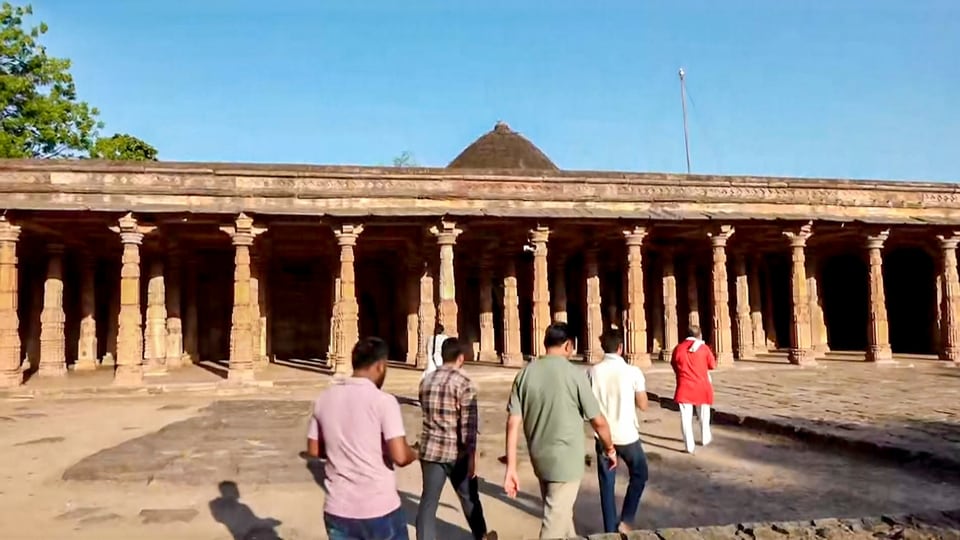
The dispute concerns the Bhojshala Temple-Kamal Maula Mosque complex in Dhar, claimed by Hindus as an ancient temple dedicated to Goddess Saraswati.


The Supreme Court on Thursday directed the Madhya Pradesh government to allow members of the Muslim community to offer Friday namaz at a separate site “adjacent to or near” the disputed Bhojshala Temple-Kamal Maula Mosque complex in Dhar, identifying a specific plot as an interim arrangement after being informed that the location earlier earmarked by the administration was over a kilometre away from the monument.
A bench comprising Chief Justice of India Surya Kant and justices Joymalya Bagchi and V Mohana accepted the Muslim side’s grievance that the state’s compliance with its July 14 interim order was not in its true spirit and permitted Friday prayers to be held at land bearing Khasra No. 596, located closer to the disputed complex.
The court also kept the door open for the parties to mutually identify a more suitable location in the future.
Also Read | 'In letter and spirit': Supreme Court directs Centre, MP govt to ensure namaz site near Bhojshala complex
“We have left open the possibility of an alternate site to be given in case both parties agree to it,” the bench observed.
The order came after senior advocate Huzefa Ahmadi, appearing for the Muslim petitioners, submitted that the administration had earmarked a site around 1.3 kilometres from the Bhojshala complex despite the Supreme Court’s direction that an open space be provided “adjacent to or near” the disputed premises for Friday prayers between 1 pm and 3 pm.
Ahmadi told the bench that the authorities had rejected several closer sites, including waqf land, citing apprehensions of law and order arising from common ingress and egress.
“They say the adjacent land to Bhojshala cannot be used by us because ingress and outgress is same and would lead to law and order situation...Can this court yield to mere threats of law and order situation?” he argued.
Appearing for the Madhya Pradesh government, additional solicitor general KM Nataraj submitted that the State was only concerned with maintaining law and order and did not wish to get into competing religious claims.
“To protect religious rights and maintain law and order is a constitutional duty of the State,” the bench told the ASG.
The bench then suggested that the authorities permit prayers on land bearing Khasra No. 596, observing that if any difficulty arose, the parties could approach the court again.
Also Read | ‘Will study SC order, take appropriate steps,’ says collector on Bhojshala issue
The dispute concerns the 11th-century Bhojshala Temple-Kamal Maula Mosque complex in Dhar, claimed by Hindus as an ancient temple dedicated to Goddess Saraswati and by Muslims as the Kamal Maula mosque.
On July 14, while declining to stay the Madhya Pradesh high court’s May 15 judgment declaring the religious character of the monument to be that of a temple, the Supreme Court sought to balance competing claims by directing the State and the Archaeological Survey of India (ASI) to provide Muslims an open space “adjacent to or near” the disputed complex for offering Friday namaz as an interim arrangement, without prejudice to the rights of either side. It had also restrained any structural alterations at the protected monument without its prior permission.
However, when the matter was mentioned before the court last week, the Muslim side complained that the administration had identified a site nearly two kilometres away. The bench had then directed the Centre and the state government to comply with its earlier order “in letter and spirit”, reminding the authorities that its direction contemplated an “adjacent site”.
The appeals before the Supreme Court challenge the May 15 judgment of the Madhya Pradesh high court, which declared the Bhojshala-Kamal Maula complex to be a temple dedicated to Goddess Saraswati, quashed the ASI’s 2003 order permitting Muslims to offer Friday prayers at the site, and observed that the Muslim community could seek alternative land from the State for construction of a mosque.
Also Read | Bhojshala row: SC to hear Muslim side's plea over location of alternative namaz site Thursday
The high court’s decision relied on the ASI’s 2024 survey report, which concluded that the monument was constructed using remnants of earlier temples and that the mosque was built centuries later. The judgment held that the Places of Worship (Special Provisions) Act, 1991, would not apply to the dispute since the monument is protected under the Ancient Monuments and Archaeological Sites and Remains Act, 1958.


