
 E-Paper



Supreme Court refers pleas challenging 2023 law on appointment of CEC, ECs to 5-judge Constitution bench
Justice Datta criticised the 2023 law, saying it vested overwhelming power in the executive and reduced the leader of the opposition’s role.

 Prefer HTon Google


The Supreme Court on Wednesday referred challenges to the 2023 law governing the selection of the chief election commissioner and election commissioners to the Chief Justice of India (CJI) for setting up a constitution bench after a split verdict by two judges.

Justice Dipankar Datta said the Union government’s demand for a larger bench to hear the challenges was unwarranted but justice Satish Chandra Sharma held otherwise. The two judges then penned a common order placing the issue before CJI, also hoping that the reference will not be inordinately delayed.
“We direct that the papers be placed before the Hon’ble Chief Justice for considering the desirability of constituting a Constitution Bench of such number of judges to decide the question of vires of Section 7 and the other provisions of the Chief Election Commissioner and other Election Commissioners (Appointment, Conditions of Service and Term of Office) Act, 2023,” the order said.
Deep Dive

Also Read I ‘Mastermind, treason, biggest scam’: Opposition attacks Gyanesh Kumar after report claims ECI dissent
A constitution bench has a minimum of five judges.
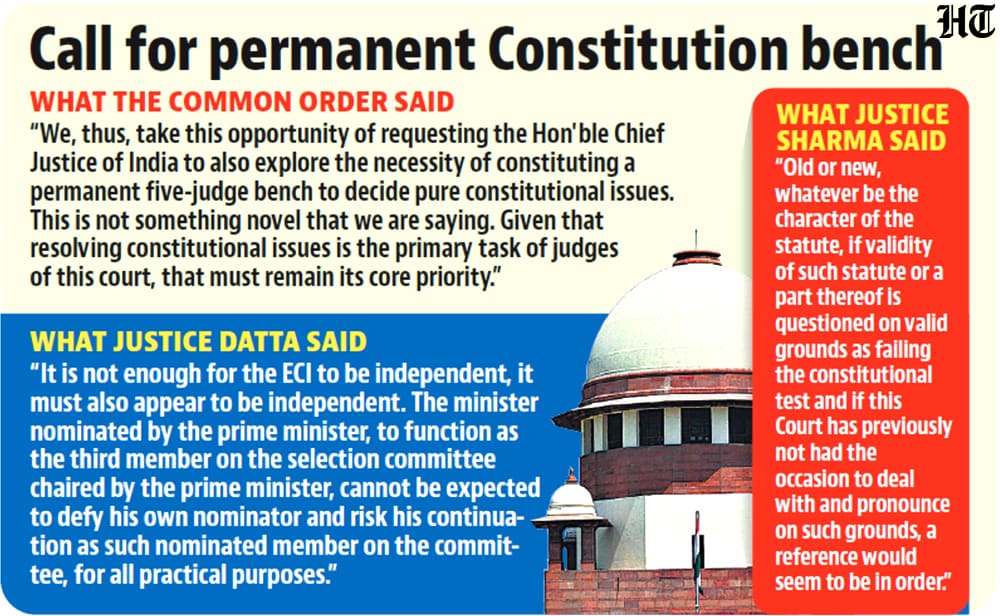
Justice Datta also criticised the 2023 law, saying it vested overwhelming selection power in the executive and reduced the leader of the opposition’s presence to largely ornamental, and questioned the “selective” process adopted by the executive in clearing collegium recommendations. Both judges also called on the CJI to set up a permanent constitution bench.
Demand for larger bench of judges
“In view of the difference of opinion between the two of us, ideally, a reference to a 3-judge bench is called for. However, having regard to the question on which such difference has arisen, i.e., whether the petitions and the applications should be heard by a Constitution Bench of 5 (five) judges, a decision by a 3-judge bench to resolve which of the two opinions is correct would be of little worth and only delay adjudication of the significant issue(s) that these writ petitions raise,” the order said.
The decision of the court came in a bunch of petitions challenging the validity of the CEC and EC (Appointment, Conditions of Service and Term of Office) Act, 2023. While the court had heard submissions of petitioners, the Centre raised a preliminary objection to a two-judge bench hearing the matter, asking for it to be referred to a larger bench to settle substantive constitutional questions.
In March 2023, the Supreme Court directed for the inclusion of the CJI in the selection panel for the CEC and ECs until Parliament came up with a new law. The judgment in Anoop Baranwal Vs Union of India, delivered on March 2, 2023, said that the selection of CEC and ECs should be done by a panel headed by the Prime Minister and comprising two other members — leader of Opposition in Lok Sabha and the CJI, to ensure transparency in the selection mechanism.
The government brought a new law -- Chief Election Commissioner and other Election Commissioners (Appointment, Conditions of Service and Term of Office) Act, 2023 -- later that year, where the composition of the selection committee was changed .
To be sure, the top court had said in its order that it was for Parliament to enact a law on the subject.
Appointments under fresh law
According to the new law, the selection process consists of two committees — a three-member search committee led by the law minister and comprising two government secretaries; and a three-member selection committee headed by the PM and consisting of a Union minister recommended by the PM and the leader of Opposition.
In March 2024, the President appointed Gyanesh Kumar and Sukhbir Singh Sandhu as election commissioners. It was the first time that election commissioners were chosen under the new law, just weeks before Lok Sabha polls.
At that time, panel member and then Congress floor leader in the Lok Sabha, Adhir Ranjan Chowdhury, gave a dissent note on the selection, calling the process rigged.
Then, when Kumar was chosen as CEC in 2025, the Leader of the Opposition in the Lok Sabha, Rahul Gandhi, also submitted a dissent note. Kumar was the first CEC to be appointed under the new law.
During the hearing, attorney general R Venkataramani and solicitor general Tushar Mehta cited Article 145(3) of the Constitution that required “substantial questions of law” relating to interpretation of the Constitution to be heard by a bench of a minimum strength of five judges.
Also Read I Differing views are normal but decisions unanimous: Election Commission amid row
Justice Datta said that important questions of law regarding free and fair elections and institutional independence of ECI did arise in these matters, the same could be adjudicated by a two-judge bench and rejected any justification to send it to a five-judge bench.
“The issue does not hinge upon whether the independence of the ECI is a part of basic structure or not. It plainly is! But does the existing jurisprudence leave amorphous a substantial question concerning the constitutional standard governing such independence? If the answer to the aforesaid is in the negative, the lis must be answered within the milieu of settled law,” he held.
Justice Sharma held otherwise. “My view on this contention is this. Old or new, whatever be the character of the statute, if validity of such statute or a part thereof is questioned on valid grounds as failing the constitutional test and if this Court has previously not had the occasion to deal with and pronounce on such grounds, a reference would seem to be in order,” he held.
LoP presence ‘largely ornamental’
In his order, justice Datta also made scathing remarks about the selection process, saying free-and-fair elections depend on an independent ECI.
“It is not enough for the ECI to be independent, it must also appear to be independent. The minister nominated by the prime minister, to function as the third member on the selection committee chaired by the prime minister, cannot be expected to defy his own nominator and risk his continuation as such nominated member on the committee, for all practical purposes,” he said.
At the same time, the judge said that the Baranwal judgment was purely “interim” and “transient” and was not a binding norm that Parliament was constitutionally obliged to follow.
The inclusion of a cabinet minister in the selection committee fails to provide the independent counterweight that a neutral selector could and he (cabinet minister) would merely echo the voice of his leader; and, consequently, the presence of the Leader of Opposition in the selection committee becomes largely ornamental, without furthering the purpose of his inclusion,” justice Datta said.
“The point urged by the challengers that since the 2023 act vests overwhelming selection power in the executive and thereby undermines the appearance of independence essential to Article 324 and the basic structure, prima facie, does appear to have substance,” he added.
Justice Datta used a cricket metaphor to summarise the challenges to the law.
“It would not be a fallacious metaphor if it is said that since the umpire is picked by the captain of one side in a cricket match and his team wins, even if the decisions taken by such umpire are correct, it has the patina of suspicion, for, at the end of the day, the umpire has effectively been chosen by the winning captain,” he added.
Also Read I ECI needs to course correct
Divided court opinion
On the other hand, justice Sharma felt that Article 145(3) could not be “short-circuited”. “Speaking in one voice would have better served institutional cohesion. Unfortunately, the court is divided in its opinion,” the two-judge order said.
The order also flagged concerns of long pendency of similar references for periods ranging between five years to over two decades.
The court requested the CJI to “explore the necessity” of constituting a permanent five-judge bench to decide pure constitutional issues.
“The issues that would engage the consideration of the 5-judge bench being of foundational importance to the democratic fabric of the country and its citizenry, we earnestly hope and trust that this reference would not suffer the inordinate delay in its resolution as in other cases,” the order said.


