E-Paper



‘World needs peace, stability and predictability’, says PM Modi at Asean-India summit in Philippines
Prime Minister Narendra Modi arrived in the Philippines on Monday to attend the summit and the 21st East Asia Summit, which is also being held in the country.

 Prefer HTon Google


India on Tuesday proposed enhanced cooperation with the Association of Southeast Asian Nations (ASEAN) in connectivity, disaster management and maritime domain awareness, as Prime Minister Narendra Modi said the two sides should use their capabilities to bolster peace and stability across the region.
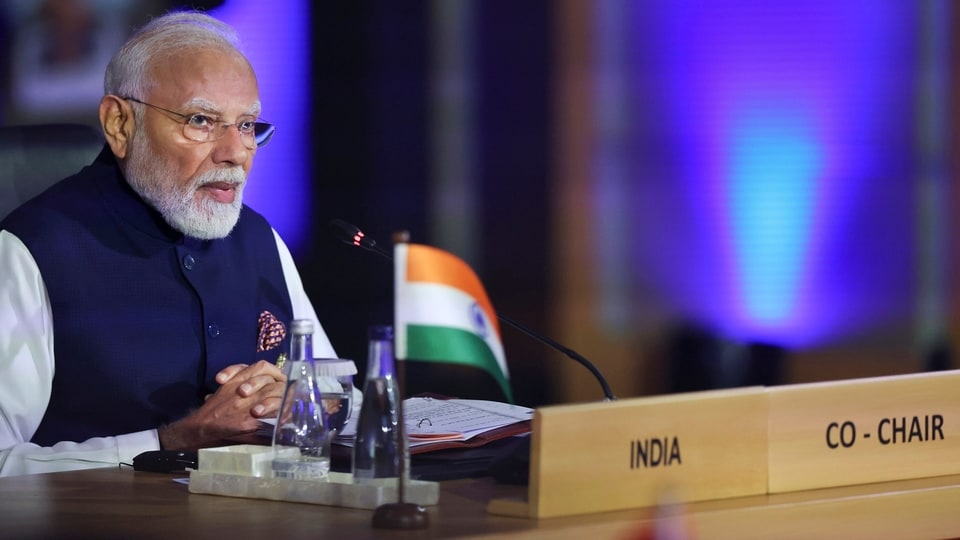
India and ASEAN must shape the future of their region as they have the strength and resolve to ensure their future is determined by cooperation and not competition, Modi said, addressing the India-ASEAN Summit in the Philippines capital. He emphasised that the world needs peace, stability and predictability after a series of crises in recent years.
Modi emphasised that the world needs peace, stability and predictability after facing a series of crises in the past few years. He pointed to the extensive cooperation developed by India and ASEAN member states over the past 12 years, including quick-impact projects and skill-building scholarships. Follow live updates related to Asean Summit here.
"Now, together, we must shape the future of our region. India's commitment to ASEAN's unity and centrality in this partnership is and will remain steadfast," he said, speaking in Hindi at the meeting held on the margins of the ASEAN Summit.
"India and ASEAN together represent nearly a quarter of the world's population. Therefore, it is essential to ensure that our future is determined by cooperation, not competition. We have both the strength and the resolve. Together, we can make this region a symbol of peace and stability," he said, underscoring the need for peace, stability and predictability after a series of crises in recent years.
Deep Dive

India's Act East policy has given new momentum and depth to relations with the 11-member bloc, and the partnership is expanding beyond shared culture and heritage to new areas such as digital, defence and space, Modi said.
Since 2014, India has taken more than 100 initiatives to strengthen people-to-people ties, launched nearly 250 quick impact projects, and provided more than 10,000 skill-building scholarships. There are now direct flights and tourism links between India and nine ASEAN member countries.
This was Modi's third visit this year to ASEAN member states, and he noted that this reflected the grouping's special importance to India.
"We believe that India's development and ASEAN's prosperity are deeply intertwined," he said, adding that the ASEAN Community Vision 2045 and Viksit Bharat 2047 can play a key role in realising shared aspirations.
India-ASEAN joint statement
India and the ASEAN issued a joint statement on cooperation in disaster management that said the two sides will bolster cooperation on early warning systems for earthquakes, tsunamis, floods, cyclones and landslides, including through sharing of satellite data, seismic monitoring information and meteorological forecasts, and strengthen consultations between the ASEAN Committee on Disaster Management (ACDM) and the ASEAN Coordinating Centre for Humanitarian Assistance on Disaster Management (AHA Centre) and India's National Disaster Management Authority (NDMA) to promote closer links between disaster management mechanisms.
The two sides will also support the use of space-based data and applications for disaster risk assessment, monitoring, and forecasting, and explore ways to conduct regular consultations within existing ACDM mechanisms to review cooperation and identify priority areas for joint action.
The two sides will also strengthen joint preparedness through regular training exercises, simulation drills and exchange of disaster response personnel between ASEAN member states and India, facilitate the rapid deployment of humanitarian assistance and disaster relief on the request of an affected member state, and encourage cooperation between armed forces and civil defence agencies of ASEAN states and India on humanitarian assistance and disaster relief.
India and ASEAN will also share experiences and best practices on post-disaster recovery and environmentally sustainable practices, support capacity building for people in vulnerable situations, and promote cooperation in advancing sustainable resilience, including through investment in resilience, resilient infrastructure, innovation, and people-centred approaches.
The joint statement said the two sides will also promote the safe, responsible and ethical application of artificial intelligence, machine learning and big data analytics for disaster risk assessment, early warning and response coordination.