E-Paper



Henri Kagan, Kenso Soai win Nobel for 'making chemistry choose a mirror image'
Kagan was born in France and is affiliated with Université Paris-Sud in France. Soai was born in Japan and is affiliated with the Tokyo University of Science.

 Prefer HTon Google


Henri B. Kagan and Kenso Soai won the 2026 Nobel Prize in Chemistry on Wednesday "for the discovery of non-linear effects and autocatalysis in asymmetric organic synthesis."
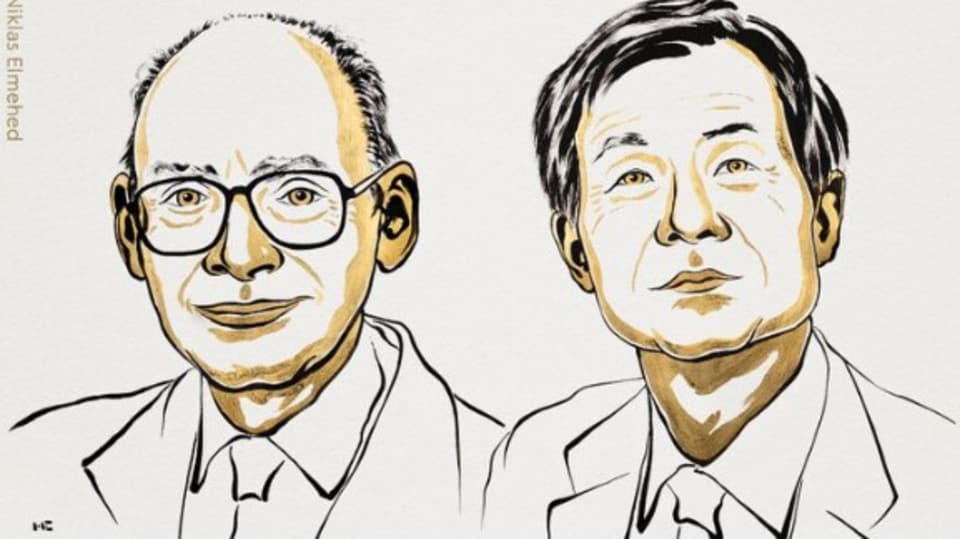
“Henri Kagan and Kenso Soai have provided a solution to a chemical mystery that is over a century old: how homochirality can emerge spontaneously,” Heiner Linke, chair of the Nobel Committee for Chemistry, said in a news release. He described the chemical reactions developed by the two scientists as “spectacular”.
Also read | Francis Halzen wins 2026 Nobel Prize in Physics for contributions to IceCube Neutrino Observatory
“They made chemistry choose a mirror image,” the award-giving body said.
Kagan, 95, was born in France and is affiliated with Université Paris-Sud in Orsay, France. Soai was born in Japan and is affiliated with the Tokyo University of Science.
Soai was shopping near his home when the Nobel committee reached out to him to tell him about the award.
The Royal Swedish Academy of Sciences announced the winner in Stockholm.
3 scientists won in 2025
Last year, three scientists won the Chemistry Nobel for developing new molecular structures that can trap large amounts of gas. Their work could help remove greenhouse gases from the atmosphere and collect moisture in dry desert areas.
Nobel prize in 2026
This year's Nobel prizes began with the Medicine Nobel on Monday, which was awarded to three scientists whose work led to a tool that uses light to help scientists study the brain.
The Physics Nobel on Tuesday recognised a scientist for work that helped improve understanding of a rare type of neutrino.
The Literature Nobel will be announced on Thursday, followed by the Nobel Peace Prize on Friday. The Nobel Memorial Prize in Economic Sciences will be announced on Monday.
The prize money this year is 12 million Swedish kronor (around $1.2 million). The amount is the same whether the prize is awarded to one person, a small group of laureates or an organisation.
Nobel Prize in Chemistry was awarded to Henri Kagan and Kenso Soai “for the discovery of non-linear effects and autocatalysis in asymmetric organic synthesis.”
The Royal Swedish Academy of Sciences announced the Nobel Prize in Chemistry on Wednesday in Stockholm.
Deep Dive

Last year, three scientists won the chemistry Nobel for developing new molecular structures that can hold large amounts of gas. Their work could help in efforts to remove greenhouse gases from the atmosphere and collect moisture in dry, desert regions.
This year's Nobel prizes began with the Medicine prize on Monday, which was awarded to three scientists whose work helped develop a tool that uses light to study how the brain works.
On Tuesday, the Physics Nobel was awarded to a scientist for research that helped scientists better understand a rare type of neutrino.
The Literature Nobel will be announced on Thursday, followed by the Nobel Peace Prize on Friday. The Nobel Memorial Prize in Economic Sciences will be announced on Monday.
The prize money this year is 12 million Swedish kronor (around $1.2 million). The amount is the same whether the prize goes to one person, a small group of laureates or an organisation.