The biggest pay bumps are instead found in the smaller towns surrounding such cities
Published on: Jul 23, 2026, 09:20:55 IST
The Economist
Prefer HTon Google
Share via
Copy link
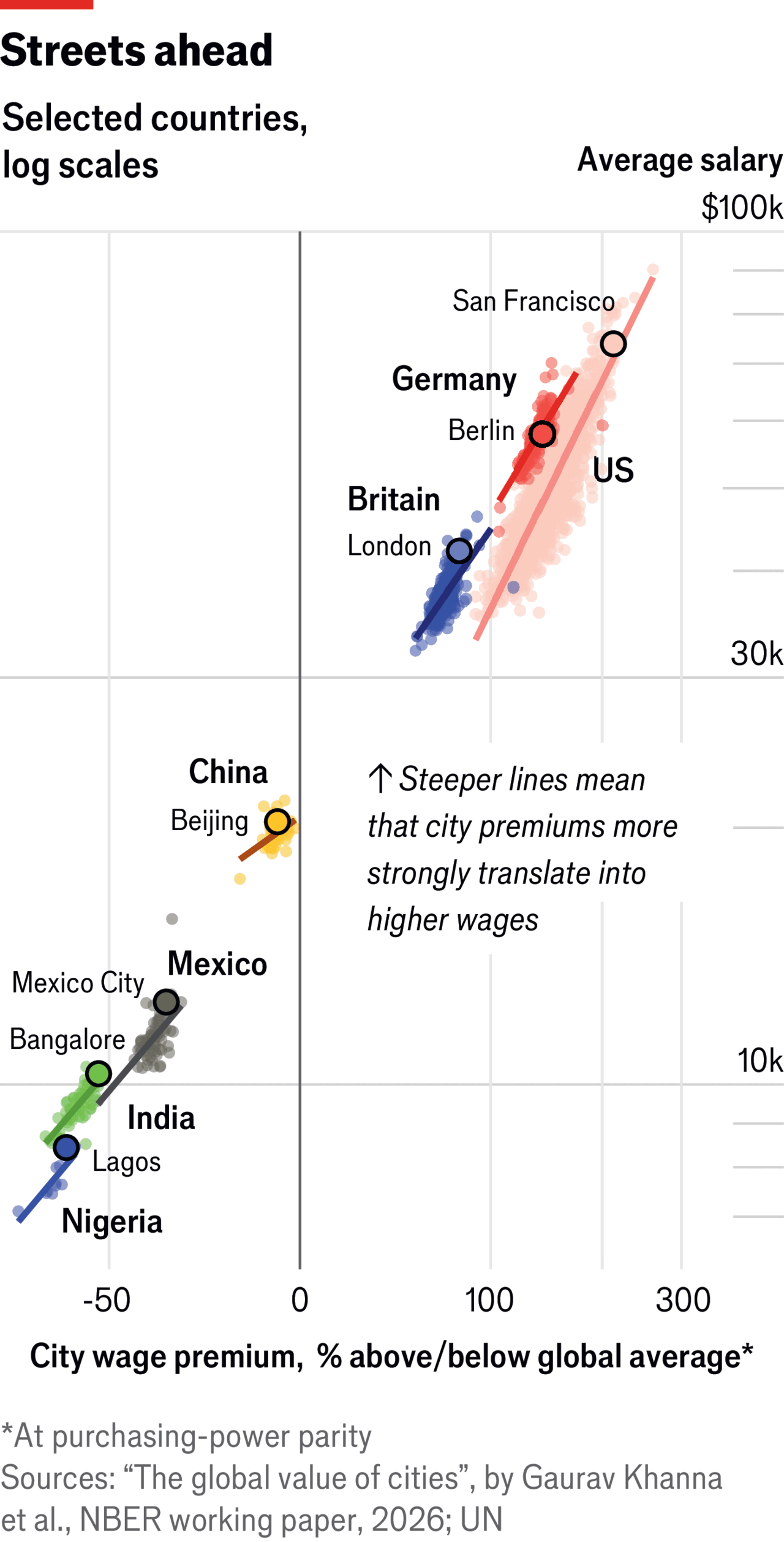
WORKERS WHO want to move for better pay might start by comparing average wages in cities under consideration. But there are two forces that can drive up such figures: a city might attract skilled people who would earn lots wherever they live or it might be somewhere that lifts wages for almost everyone via the productivity-enhancing magic of agglomeration. A migrant should aim for this second class of city.Untangling the impact of “place” and “person” is tricky, however. In a recent paper Gaurav Khanna of the University of California, San Diego and his co-authors do so by looking at the job histories of more than 500m people on LinkedIn, a careers platform. By tracking white-collar workers as they move to various cities, the researchers are able to estimate how much changes in their pay can be explained by place alone. Their results offer a guide to pay for like-for-like work. Our tool below compares location premiums across more than 300 cities.
work (unsplash)
map
Mr Khanna’s estimates suggest that place accounts for 45% to 73% of the wage gap between cities in a given country, with the rest down to individuals. Across borders, and after adjusting for purchasing power and inflation, place accounts for 93% of such wage gaps. Vaduz, capital of tiny Liechtenstein, has the biggest premium, although its population of 6,000 people might put off some migrants. Among big countries, American cities rank highest. The largest premiums tend to be in large, dense and industrially diverse cities with plenty of job opportunities, such as San Francisco and New York.
In rich countries, cities with big location premiums are usually also those with the highest average wages, so workers chasing pay end up in economically efficient places. But the same is not true in poorer countries. When Indians, for example, flock to big, high-wage cities such as Bangalore, many end up with small wage premiums. The biggest pay bumps are instead found in the smaller towns surrounding such cities. They share some of the same agglomeration benefits without suffering as badly from scarce housing, patchy electricity and congested transport.
These constraints affect companies, too. In America the most productive firms, which offer genuine wage premiums, are able to grow and employ more workers. In lower-income countries they are often held back by the same bottlenecks as workers, meaning that employment shifts to less efficient firms that hire more people but pay them less.
The authors calculate that if India’s most productive cities could house the same share of workers as America’s, average wages would rise by 2.3% across the country. If the same share of workers was also employed by the most productive firms, the total gain would rise to 4.3%. Similar reshuffling would raise Mexican wages by 5% and Nigerian ones by 8%.
Workers often cannot see whether a city pays well because it is genuinely more productive or because talented people already live there. Helping them reach the right places could unlock economic growth.
Get the latest World News, breaking headlines and global updates from the US, UK, Pakistan, Bangladesh, Russia and other countries. Follow major international events on Hindustan Times.

 E-Paper





 Prefer HTon Google