


 Live Score
 Teams
 Players


Rasesh Mandani loves a straight drive. He has been covering cricket, the governance and business side of sport for close to two decades. He writes and video blogs for HT.
The curious case of Mohammed Siraj’s non-selection
The pacer who always steps up when Jasprit Bumrah is rested has lost the faith of the team management
Updated on: Nov 26, 2026, 20:33:16 IST


Share via
Copy link
Before India's Test series against New Zealand began, the focus was sharply on India’s batting unit: Whether the batters will have the answers to counter the new ball on pitches with a green tinge. Five days of toil in Wellington later - the pitch flattened out faster than product sales after a holiday shopping spree - conversations shifted towards India’s bowling attack: If their pack of four pacers was right for the conditions.
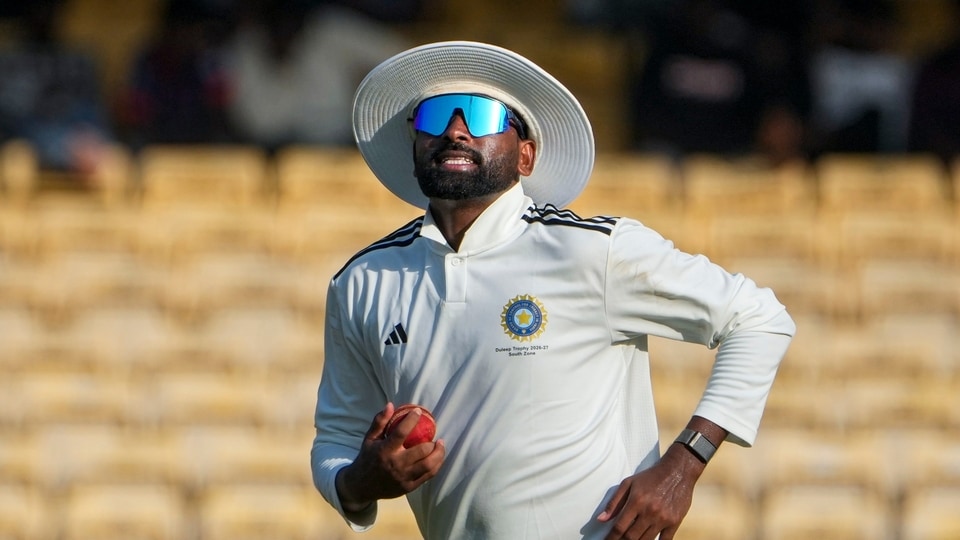
Experts widely agree that the Indian team erred in judgment by dropping Mohammed Siraj. His non-selection became a political talking point too, but that theory was unequivocally rubbished.
In another world, Siraj would have played both the Tests and achieved a landmark of 50 Test matches. So, why the disconnect between the team management and the outside world? The outside view, as team set-ups like to call it, has been broadly based on Siraj’s bowling pedigree. His tireless spells, his heroics from last year’s England tour, his record in the current WTC cycle (most wickets - 43 - by an Indian) among other things. But a WTC cycle runs across two years and sometimes, that’s far too long for a bowler to retain rhythm. Certainly with Siraj, who, the decision makers seem to argue, has lost a lot of verve that makes him the bowler he can be.
They haven’t said it so clearly, but one can attempt to connect the dots. “Sometimes you have to see which bowlers are in form, which bowlers are bowling the best,” Shubman Gill said after the Wellington Test match.
"The conversation I had with him was to say, ‘Listen, let's just step it back a little bit. Where are we at the moment, what do we need to improve, and where can we get better?,” Morne Morkel said on Thursday, on the eve of the second Test match.
Not in form, scope for improvement—this generally classifies as grounds for another non-selection, unless the Indian team wants to throw everyone a dummy.
Long rope or not?
It leads one to debate whether bowlers are less trusted than batters to regain bowling form in the middle. From time to time, team managements tend to go funky with selections, even in Test cricket. Occasionally, they have done it with batters too. Go back to the mid-2010’s when then captain Virat Kohli and head coach Ravi Shastri felt uneasy with Cheteshwar Pujara’s strike rate and expected more out of Ajinkya Rahane. The two senior batters responded with the bat upon their comebacks, which settled the issue.
Somehow, with bowlers, there is less leeway. There is reluctance to give them a longer rope. Bowlers are typecast as being conditions-specific - some pacers suited to bowl in the sub-continent to attack the stumps, a few come in when slips are expected to be in play for longer, specific spinners for slow turners and the like. Gill and head coach Gautam Gambhir’s selection of the playing eleven, let’s say, has been unconventional.
We have seen that with Kuldeep Yadav. R Ashwin’s retirement was seen as an open door for Kuldeep to take the lead spinner’s position. With the left-arm unorthodox sitting out through last year’s England tour, it never panned out that way. Kuldeep hasn’t been able to regain trust or rediscover confidence.
With fast bowlers, selection is also down to managing bowling workloads. However, Siraj's drop in form is not necessarily down to overwork. He touched upon his lost rhythm while speaking to reporters during the Duleep Trophy in September, immediately after the Sri Lanka tour.
"I'm purely a rhythm bowler,” he had said. “If I'm not in sync, I can't explode through the crease. That was the struggle in Sri Lanka - my run-up felt disjointed. Some strides were too short, others were too long, and that broke my flow and cost me pace.”
“Every bowler's body is different, but mine doesn't handle long breaks well,” he added.
And rebuilding bowling workload is difficult with today’s convoluted playing schedules spread across formats. Fast bowlers are prone to losing direction. After the Sri Lankan tour in August, where Siraj was short of a gallop, he has played in four first-class matches and two ODIs. Before the Sri Lankan Tests, he also played the one-off Test match against Afghanistan, days after a hard two-month IPL grind. Somewhere in this churn, Siraj lost the faith of those sitting in judgement of his selection.
To the outside view again where many experts argue that Siraj is too good to fail for too long and should be an automatic pick outside the subcontinent. Every time Jasprit Bumrah has rested, Siraj has stepped up admirably.
It’s important that Indian cricket charts a way back for Siraj and ensures he does not become a victim to Chinese whispers.
ABOUT THE AUTHOR

Get live cricket scores, match updates, schedules, results and ICC rankings. Follow the latest news, statistics and performances of top teams, players update on Hindustan Times.


