E-Paper



Rethinking Viksit Bharat: China, G7 and contest for the world | Number Theory
No large country in the world has ever managed sustained high growth without exports. India can't be an exception if it has to achieve high-income nation status
Updated on: Aug 31, 2026, 07:19:13 IST

 Prefer HTon Google
Share via


Copy link

The first and second parts of this series discussed India’s manufacturing predicament in detail. No large country in the world has ever managed sustained high growth without exports. India cannot be an exception if it has to achieve high-income country status. Meanwhile, the world has changed from the days when exporting to advanced countries was the path to wealth.
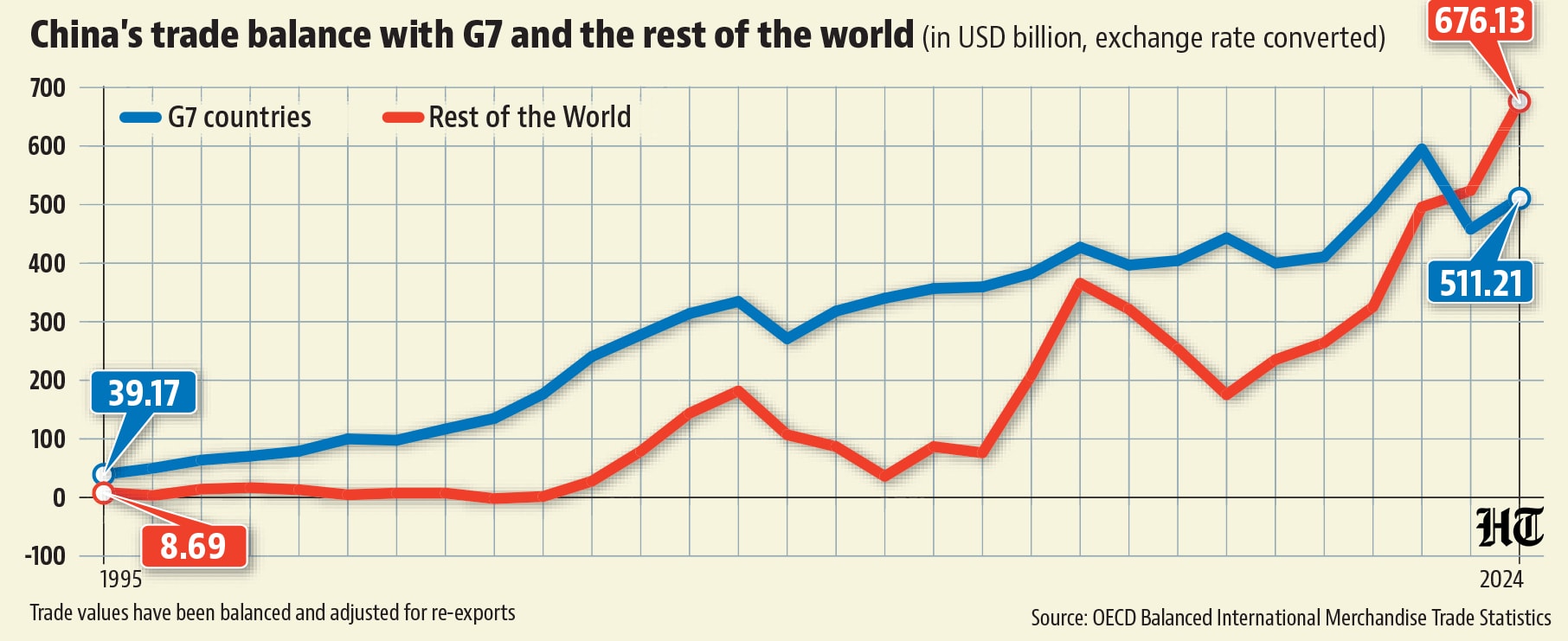
 China now runs a bigger trade surplus with the rest of the world than with the G7For much of the past three decades, China’s trade surplus looked primarily like a rich-world problem. The G7— Canada, France, Germany, Italy, Japan, the UK and the US—bought far more from China than it sold there. China ran a $314 billion surplus with the G7 in 2007, more than twice its $144 billion surplus with everyone else, according to data from OECD’s Balanced International Merchandise Trade Statistics (BIMTS), which balances reported bilateral trade values and adjusts them for re-exports. That is now changing. As of 2024, China’s surplus with the G7 stands at $511 billion, while its surplus with the rest of the world ballooned to $676 billion. The latter overtook the former for the first time in 2023.
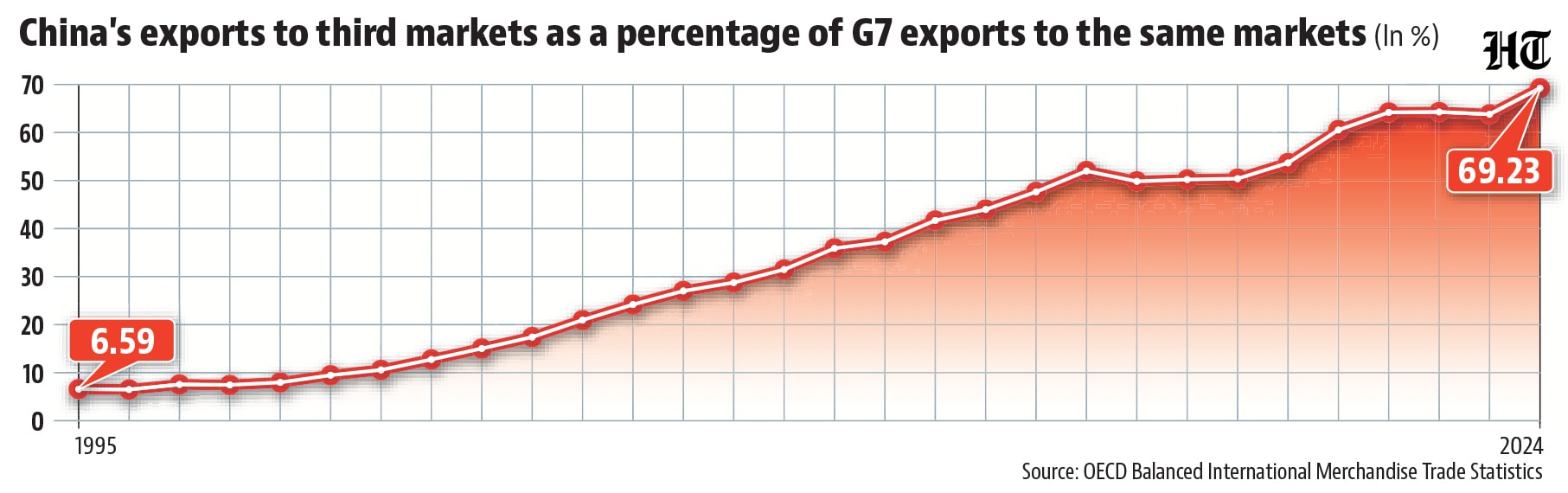
- The real contest is now in third-country marketsIn 1995, for every $100 worth of goods the G7 exported to countries outside China and the G7 itself, China exported barely $7. However, as of 2024, this is as much as $69 for every $100 exported by the G7 to the same third-country markets. A recent study published by the Kiel Institute for the World Economy, finds that China’s export gains are increasingly concentrated in machinery, vehicles, chemicals and other complex manufactures long dominated by advanced economies. “China’s move toward more complex products, together with its export growth in these categories, has strongly affected advanced economies since a major competitor has emerged that is growing precisely in the product categories in which these countries specialize,” said the report.
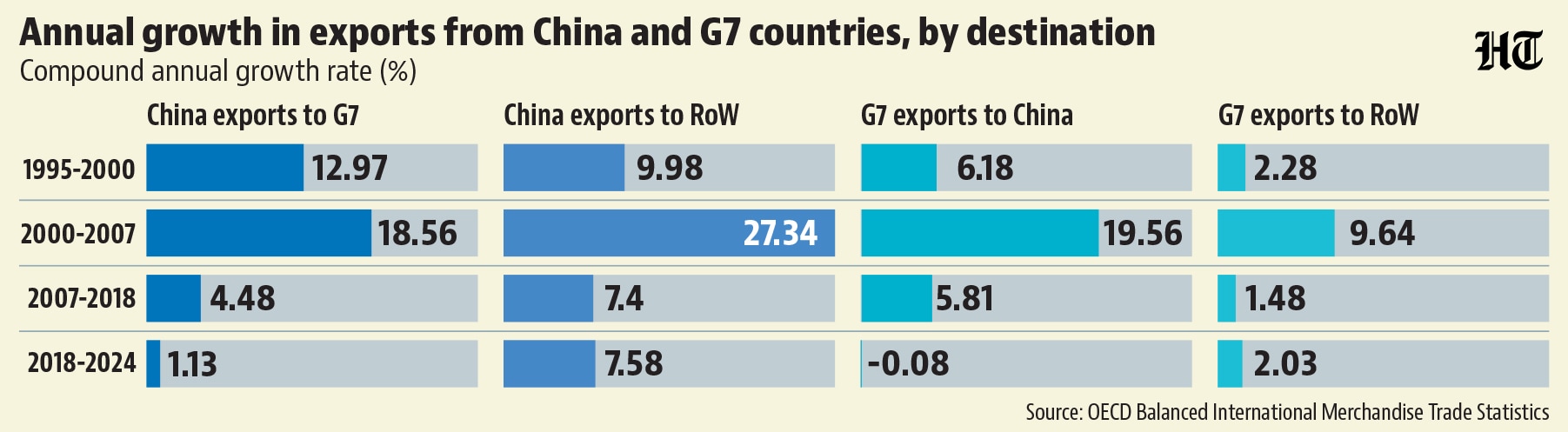
- To be sure, G7 is still increasing its exports, China is just doing it fasterTo see what has changed, it helps to split the years since 1995 into four phases. The years 1995-2000 give us a pre-WTO baseline—China was already gaining ground, with its exports to third markets growing at a rate of 10% annually, compared with 2.3% for the G7. China’s accession to the World Trade Organization in 2001 then ushered in what the US Federal Reserve in a recently published note called the first “China shock”. The next period, 2007-18, captures the much slower global financial crisis and post-crisis era of global trade. Finally, 2018-24 covers what the US Fed calls “China Shock 2.0,” a renewed export push from a country that was already the world’s dominant goods exporter. China’s entry into the WTO in 2001 accelerated reforms, investment and its integration into world trade, helping explain the extraordinary 27.3% annual growth rate in its exports to non-G7 markets between 2000 and 2007. To be sure, G7 exports to China also grew 19.6% annually over the same period. China was becoming a formidable competitor, but also a rapidly growing customer. The financial crisis ended the boom years for global trade. China slowed too, but between 2007 and 2018 its non-G7 exports still grew 7.4% annually against 1.5% for the G7. Since 2018, the relationship has become more lopsided. China’s exports to the G7 recorded an annual growth rate of just 1.1% and G7 exports to China shrank marginally, while Chinese exports to non-G7 markets grew at a rate of 7.58%, much faster than G7’s exports to this group.
- China’s rise used to be easiest to spot on Western shop shelves. The more uncomfortable part for the West now is what is happening elsewhere. China is increasingly selling to the same customers they depend on, while buying less from them in return. The second China shock is therefore as much a fight for export markets as an argument over imports. For India, that creates an opening, but hardly an easy one. The real prize is not merely replacing China in Western supply chains, but becoming more competitive in the same third markets where China is already deeply entrenched, which will require much deeper trade integration and global value-chain participation. This cannot happen without a new deal for manufacturing in India.