
 E-Paper



'A very exceptional thing': Why Opposition wants to take up NEET paper leak in Parliament with an adjournment motion
It suspends the day's business, ends in a vote and counts as censure if successful. That is why the Opposition wants it and why Speakers have rarely allowed it.


The government indicated on Thursday it was willing to debate students' issues "the way the Opposition wants it" — an offer that was seen as a tacit acceptance of the demand for an adjournment motion, among the sharpest devices available to MPs who want to corner the government in Parliament.
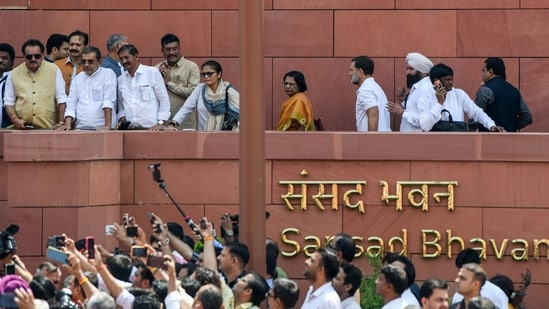
Parliamentary affairs minister Kiren Rijiju told the Lok Sabha that the message had been conveyed to the Opposition through the Speaker. The government was ready to discuss the NEET paper leak in both Houses, he said, and would accept the Opposition’s choice of date and format.
Lok Sabha Speaker Om Birla said earlier in the day that the form of the debate was itself open to negotiation. The House was ready to take up every issue, he said, asking members to return after Question Hour, so that all parties could be consulted on the rule under which they wished to hold the discussion. The House was thereafter adjourned.
The exchange came on the 48th day of the protest launched by the Cockroach Janta Party (CJP) after the NEET-UG medical exam paper leak this year.
Protests by CJP, which began as a satirical outfit, gained momentum as activist Sonam Wangchuk began an indefinite fast and thousands – most of them youngsters – gathered in Delhi to show their support. The demonstrations turned violent this week as police and paramilitary forces deployed in and around the protest site used lathis, tear gas and water cannons to control a swelling crowd. The government has since reached out to Wangchuk, who broke his fast late on Thursday night, and CJP for talks.
Students' protest: Live updates
Why Opposition wants an adjournment motion
Typically, Parliament runs on a list. Lawmakers must give the presiding officers advance notice of the matters they wish to raise, the government must give advance notice of its bills, and the secretariat of each House compiles both into a list of business for the day. Members can debate only what is on that list.
An adjournment motion is the mechanism that sets this list aside. The rule allows an MP to ask the Speaker to adjourn the business of the House to take up a definite matter of urgent public importance. The Speaker decides whether to let the member move it.
Once admitted, an adjournment motion displaces the day's scheduled business — including Question Hour and Zero Hour — so that the House can debate nothing else.
The definition of the motion on the government's Sansad website says:
"A motion for discussing 'a specific and important matter that should have urgent consideration'. It can be moved by any member of the House and is in the nature of emergency motion of censure upon the Government. The object is to draw the attention of the government to a matter of urgent public importance so as to criticise the decision of government in an urgent matter in regard to which a motion or resolution with proper notice will be too late."
The motion’s edge lies in what follows the debate. A discussion under the rule ends with a vote. A government that loses that vote has been formally censured by Parliament.
For an Opposition, winning it counts as a major political victory. That is also what makes the device symbolic for any government to concede because agreeing to a debate under this rule, in effect, means agreeing to a vote on its own conduct.
Where the rule comes from
The adjournment motion is a British import, according to an account of its history by Chakshu Roy of PRS Legislative Research.
It began in the House of Commons and came to India through the legislature set up under the Government of India Act of 1919. Members of the central assembly and the legislative councils used it, and presiding officers let them. They had little choice: there were few other ways to force an urgent matter onto the floor, and the colonial administration did not answer to the legislature in any case. A censure debate was one of the few levers members had.
Independence removed that argument. Under the Constitution, the government answers to the Lok Sabha for what it does. So when the two Houses wrote their rulebooks in 1952, the motion went into the Lok Sabha’s and was left out of the Rajya Sabha’s, because that answerability runs to the Lower House alone.
GV Mavalankar, the Lok Sabha’s first Speaker, then made clear that the motion was not meant to become routine. He called it a “very exceptional thing”, to be used when something grave enough to touch the country's safety and interests had happened and the House had to turn to it at once.
Conditions had changed entirely under the new Constitution, he said, and with a government now answerable to the House, the motion could not be treated as a normal way to open a discussion on any important matter.
Conditions apply
The rulebook fences the motion in. Because it interrupts the ordinary business of the House, it is treated as an extraordinary measure and needs the support of at least 50 Lok Sabha MPs to be admitted.
Once admitted, the discussion cannot run for less than two-and-a-half-hours.
The subject matter is restricted too. A motion must raise a matter that is definite, factual, urgent and of public importance, and must confine itself to a single matter of recent occurrence. It cannot raise a question of privilege, revive a discussion already held in the same session of Parliament, deal with a matter that is before a court, or raise anything that could be brought up through a separate motion.
Lok Sabha speakers have applied these conditions strictly, on the reasoning that the rule book offers members other ways to raise urgent matters.
Roy said in his 2023 analysis that most Lok Sabhas had spent under 3% of their time on adjournment motions, and that admissions were a fraction of notices filed. The highest count was 24 admitted out of 5,762 notices received in the 7th Lok Sabha.
The exception was the 9th Lok Sabha of 1989-91, under Speaker Rabi Ray, which gave the device almost 5% of its time, or 36 hours, and took up eight motions on subjects, including terrorism in Punjab, the criminalisation of politics and the violence that followed the decision to implement the Mandal Commission report.
The last adjournment motion to be discussed dates to 2015, on former Indian Premier League (IPC) commissioner Lalit Modi leaving India after being embroiled in cases related to financial irregularities.
The years since have produced attempts at introducing the adjournment motion, rather than debates. Congress’s Manish Tewari sought a motion in 2021 over the alleged misuse of Pegasus spyware by the government, and Manickam Tagore, also of the Congress, in 2023 over violence against women in Manipur. Neither notice was admitted.
Also read: No lengthy speeches, GenZ are redefining language of protest with memes, sarcasm & costumes
Opposition reaction
For now, the government's inclination reached the Opposition through back channels and was placed before its strategy meeting on Thursday morning, HT reported on Friday.
But political leaders, including Leader of Opposition in Lok Sabha Rahul Gandhi and Samajwadi Party chief Akhilesh Yadav, have not yet agreed to hold the talks until their other demand – the resignation of education minister Dharmendra Pradhan – is met.


