
 E-Paper



Dharmendra Pradhan steps down, Gen Z steps up
Minister Pralhad Joshi gets additional charge of education, BJP leaders rally behind Pradhan after he resigns.


A 36-day stir by students achieved a landmark victory on Saturday as education minister Dharmendra Pradhan resigned following weeks of sweeping protests that brought central Delhi to a halt, energised a moribund Opposition, and heralded the entry of a new generation of young people into politics.
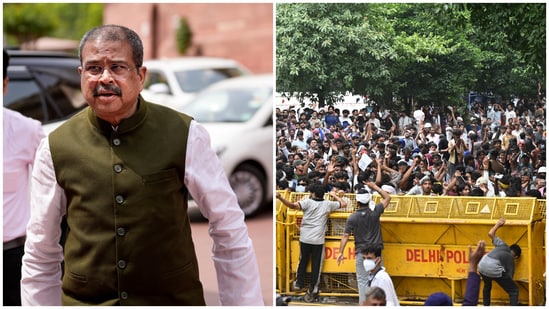
The sprawling sit-in in Delhi’s historic Jantar Mantar was called off hours after the resignation was announced by the minister on X with leaders of the Cockroach Janta Party (CJP) saying the government had accepted two other demands – compensation of ₹1 crore to the kin of every student who died by suicide following irregularities in the National Eligibility cum Entrance Test, and the withdrawal of all first information reports against students who undertook a massive march to Parliament earlier this week.
“We have won. Gandhi has won. Ambedkar has won,” CJP founder Abhijeet Dipke said from the makeshift stage in Jantar Mantar as news trickled into the heavily barricaded site.
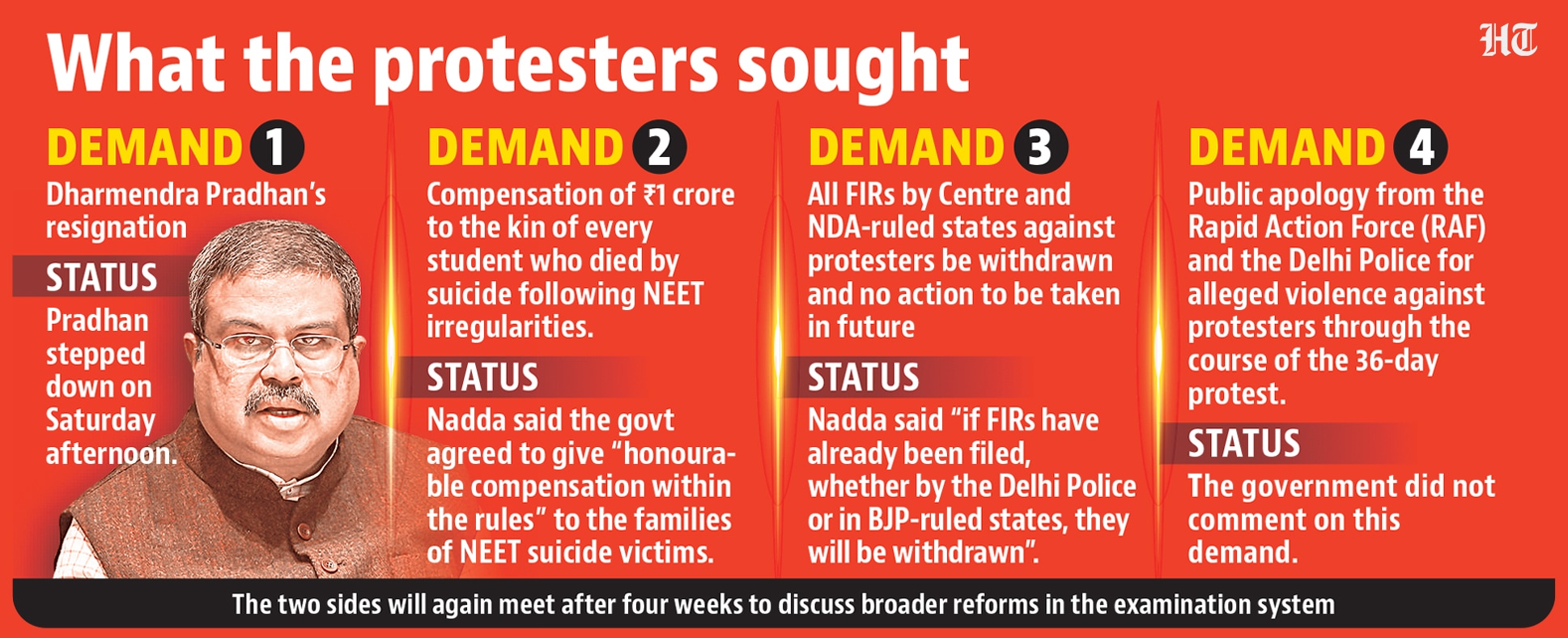
This is the first time that a popular street protest has forced the resignation of a Union minister in the National Democratic Alliance (NDA) government’s three terms. Union consumer affairs minister Pralhad Joshi was given additional charge of the education ministry.
Also read: Fear of losing Gen Z, poll math forced BJP's hand in Dharmendra Pradhan's resignation
Celebrations erupted soon after as young men and women – many of them Gen Z -- waved the Tricolour, climbed barricades and broke into impromptu jigs as makeshift loudspeakers belted out Bollywood favourites. Many briefly interrupted festivities to stand in attention and loudly sing along to the national anthem and Saare Jahan Se Acha, before unfurling their banners and posters featuring memes and slogans hitting out at the government.
“Our generation did it. We showed them that you cannot call us terrorists, hit us, and go scot free,” said Nachiket Malhotra, 22.
Pradhan – one of the seniormost ministers in the Cabinet who was a part of the council of ministers since Prime Minister Narendra Modi swept to power in 2014 and the longest serving education minister in almost two decades – announced his dramatic resignation on X.
In his two-page note in Hindi, the minister said he was disturbed to see the events of the past 10 days, and said he had resolved to not let the youth get ensnared in the web of confusion.
“Considering the situation at Jantar Mantar and across the country-with the aim of preventing anti-national forces from exploiting it, preserving national unity, ensuring that not a single Indian student’s future gets entangled in legal complexities, and allowing our children to devote their time to studies and focus on building their careers-I have submitted my resignation to prime minister,” he said.
“It is not a matter of individual prestige for me,” he added.
Rashtrapati Bhavan accepted his resignation even as senior ministers and Bharatiya Janata Party leaders rallied behind him. “His contribution to public service has been inclusive, future-ready, and aligned with the aspirations of a New India,” defence minister Rajnath Singh said on X.
Hours later, CJP representatives Ashutosh Ranka and Saurav Das met Union ministers JP Nadda and Jitendra Singh – for the third time in as many days – and announced later that the government had accepted all their demands. The two sides will again meet after four weeks to discuss broader reforms in the examination system, the CJP said.
Also read: NEET can’t continue as a make-or-break exam
“The CJP declares that we withdraw the agitation in good faith and understanding that the agreed-upon terms will be executed within the agreed-upon timeline,” Das said at a joint press conference with Nadda and Singh.
“As the government accepted all our demands after 36 days of protests, we appeal to everyone to peacefully withdraw from protest sites and go home,” Ranka said.
Das said they have shared a draft of the demands with the government and the government will share a written guarantee by Tuesday. There was no word on the demand for an apology from the government over clashes on July 20.
Nadda said the CJP representatives came to the meeting with a written draft on cases filed during the July 20 agitation. Delhi Police have filed at least 15 FIRs in connection with the protest when tens of thousands of young people broke barricades, braved tear gas shells and batons to march to Parliament.
Nadda said the government also discussed demands of no retaliatory measures against agitators, compensation for the families of NEET aspirants who died, and a five-point CJP charter.
Also read: New paper leak bill prescribes 2-month window for probes, speedy trials
“After the discussion, the first point was that no action should be taken and no FIRs should be filed. If any FIRs have already been registered, whether by the Delhi Police or in BJP-ruled states, it will be withdrawn,” Nadda said, adding that the government agreed to give “honourable compensation within the rules” to the families of NEET suicide victims.
“All our demands have been accepted by the government,” Das said. Nadda said the government will provide to CJP copies of FIRs registered.
The announcements drew a dramatic denouement to the sweeping protests that were birthed by a controversial comment by Chief Justice of India Surya Kant describing unemployed people and dubious degree holders earlier this year.
“I thank CJI Surya Kant ji for calling us cockroaches. If you had not called us cockroaches, I would not have returned to India. If you hadn’t called us cockroaches, the youth would not have been on the roads,” Dipke said at Jantar Mantar to cheers.
The CJP first garnered millions of followers on social media before launching an indefinite sit-in protest on June 20 demanding the resignation of Pradhan over repeated question paper leaks – including one earlier this year. After days of tepid crowds, the movement was galvanised by the hunger strike and forcible removal of activist Sonam Wangchuk last week.
Crowds swelled through the weekend and by Monday morning, columns of people –– many of them students, first-time agitators and young professionals –– had defied a steady drizzle and police barricading to join what became the largest street protests in Prime Minister Narendra Modi’s third term. Over 100 protesters and 129 security personnel were injured. One protester remains in the ICU.
Over the past week, crowds swelled and spilled beyond the confines of Jantar Mantar as thousands of young people poured into central Delhi, despite the longest spells of internet shutdown and metro station closure in Delhi, scores of barricades that sparked traffic snarls across the Capital, and controversial police detention from roads over protesters carrying posters or pepper spray. Tensions sporadically flared at the site, most dramatically on Wednesday night when clashes between protesters and police led to injuries to five agitators and five police personnel.
As the storm of Gen Z protesters grew, the government’s efforts to break the impasse kicked into overdrive. Nadda and Singh convinced Wangchuk to break his fast, Modi made a rare personal appeal to young people on Instagram and promised a stringent new bill – which will come before Parliament on Monday – to tackle paper leaks, and the National Testing Agency fired top officials. The police continues to be under fire over allegations of excess force used to scatter crowds on July 20; the Supreme Court is set to hear two appeals on Monday even as four people have alleged that the security forces used pellet guns on them – an unprecedented occurrence in the Capital.
But on Saturday afternoon, as an avalanche of people – many of them school students, many first-time protesters who had never stepped outside campuses before, many who travelled a night or more to be there – thronged Jantar Mantar, the jubilation around their achievement had washed away the bitterness. “Everyone thought we were lazy, we don’t know anything beyond Instagram or our phones,” said Nikita Joshi, 19. “Today, our generation raised its voice.”


