
 E-Paper



Selfie cam, midnight post: How PM Modi's ‘GenZ-style’ video sparked its own story with ‘peak detailing’
Some users compared the PM's selfie camera angle to the low, close, slightly-off shot via a peephole in a scene from the 2011 cult comedy ‘Delhi Belly’


Landing in the middle of a persistent protest by the Cockroach Janta Party (CJP) at Jantar Mantar in Delhi, Prime Minister Narendra Modi's video promising tough action over paper leaks ran under three minutes and promised fast-track courts. Within minutes, a large part of the argument online had nothing to do with what he said. It was about how the thing was shot.
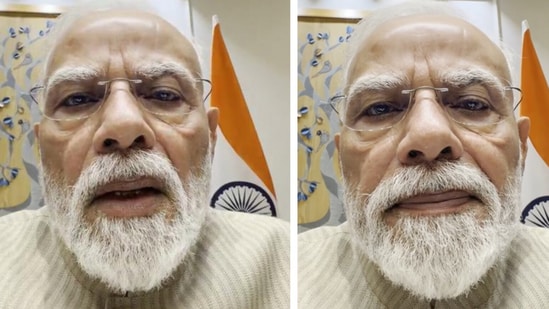
PM Modi put the message up at 11.52 pm on Thursday. He called viewers “Friends” and spoke straight into what looked like a phone's front camera, held at arm's length. No podium, no studio, no formal backdrop. For a leader whose addresses are usually announced days ahead and treated as events, the vertical selfie for such an occasion was new. Millennials and those older would remember the sound of “PM to address the nation at 8 pm” before the 2016 demonetisation of high-value currency notes, but this was for Gen-Z.
The format became the story, expectedly.
‘Peak detailing’
“Modiji using front camera to make video look like it's an Insta reel, because, you know, he is speaking to the Gen Z kids... Peak Detailing...” posted an X user named Sreeju Sudhakaran. The phrase “peak detailing” did double duty here. It has been circulating as a compliment-cum-riff for filmmaker Aaditya Dhar's ‘Dhurandhar’ series, which a section of critics reads as sympathetic to the government's line on decisions including demonetisation.
A central question was asked by several others, such as ‘The Forgotten Man’ on X: “Is it Genz style to impress the GenZ audience?”
Satirist Akash Banerjee, who posts as The DeshBhakt, sought to pur focus on the protest's central demand. If not Dharmendra Pradhan's, the Prime Minister should at least accept his cameraperson's resignation, Banerjee said on X.
Some others pushed the camera-angle comparison further, likening the low, close, slightly-off angle up the chin to a peephole shot from the ‘Loondry!’ scene from the 2011 cult comedy ‘Delhi Belly’.
There was some praise, too, for the aesthetic choice, citing the numbers it got. X user Mahesh Vikram Hegde noted the video got millions of views on Instagram, besides on other platforms. “This is nothing but crazy aura. People celebrate when a movie trailer gets 10 million views. But imagine a selfie video posted by Modi ji at 12 midnight getting 260M+ views... Even today, he is India's Rockstar,” he wrote.
“That perfectly awkward front-camera selfie angle, carefully crafted to look completely spontaneous, is just one of the many reasons Modi and the BJP are so good at the social media game,” posted another user named Anirudh Kejriwal.
But evidently younger users called the selfie “millennial-era style”, suggesting the PM use a mirror-selfie framing instead.
The style did face politically loaded barbs too. The condition of protest is so intense, said a user named Sakshi, that PM Modi needed to record the video with a front camera; “otherwise he goes with personal photographer everywhere.”
That is the argument the CJP led by Abhijeet Dipke and the Opposition led by Rahul Gandhi have been making too, insisting that the PM is under pressure, particularly after the police crackdown on the CJP's Parliament march.
How CJP, Oppn reacted
CJP spokesperson Ashutosh Ranka told reporters on Friday that the Prime Minister had to release a selfie video at midnight for the first time, and that this showed the pressure was very high. The strictest action would be removing Pradhan, he said, speaking on Modi's promise for strict action.
Ranka and Dipke are social media and comms experts who have worked for the AAP, for instance, in the past; and the AAP is known to be savvy with meme content and sharp one-liners.
Congress president Mallikarjun Kharge, meanwhile, objected to the where PM Modi spoke. “When Parliament is in session, the Prime Minister has to give a statement on the floor of the House; he should not make a late-night video and do a one-sided 'Mann Ki Baat' outside Parliament!” Kharge wrote on X, demanding that education minister Pradhan be dismissed before Modi walks into Parliament next.
Leader of Opposition (Lok Sabha) and Congress MP Rahul Gandhi called it a “pathetic midnight video” and listed three demands: sack Pradhan, punish those who beat students, and apologise.
Congress comms incharge Jairam Ramesh said PM Modi looked “desperate and hassled” in the video, and noted that his message did not mention the protests or the police action against them.
What he actually said
In the video, Modi said the paper leak was no trivial matter and had caused pain to lakhs of students and their parents. The guilty had been arrested and were in jail; and the priority had been making sure no student lost a year, he said. Around 22 lakh sat the retest; results came on July 19.
He said he had told departments to draw up provisions for fast-track courts, that the draft reached him the same night, and that the Union cabinet would take it up on Friday.
Finance minister Nirmala Sitharaman also defended the handling of the issue, saying the government had been sensitive to students' concerns and had delivered arrests, re-exams and results on time.
The CJP, which is now in talks with the government as of Friday afternoon, has said Jantar Mantar stays occupied until Pradhan resigns.


