
 E-Paper



Ghaziabad orders hybrid classes for students up to Class 5 amid ‘poor’ air quality, GRAP-3 curbs
The Ghaziabad district administration also extended the ban on all public and private construction and demolition activities till November 20.

 Prefer HTon Google


The Ghaziabad district administration on Wednesday directed schools to operate in hybrid mode till Class 5, wherever possible, and extended the ban on all government and private construction and demolition projects till November 20. The directions were issued for effective compliance of stage 3 of the Graded Response Action Plan (Grap), which is in effect due to a rise in pollution levels.
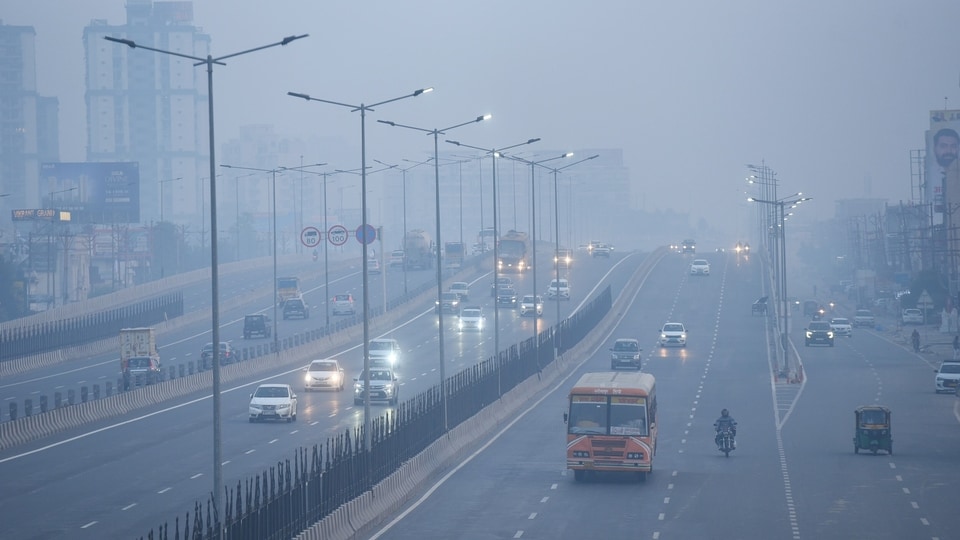
Similar orders were issued in Gautam Budh Nagar, where the district basic education department directed schools to conduct classes in hybrid mode for students up to Class 5 from Thursday. The order applies to all government, government-aided and recognised schools in the district. The directions followed the Commission for Air Quality Management's (CAQM) directions under Stage III of the Graded Response Action Plan (GRAP).
In Ghaziabad, district magistrate Ravinder Mandar on Wednesday held a meeting with the officials of different departments/agencies like the UP pollution control board, transport department, Ghaziabad municipal corporation, public works department, and others.
The district magistrate also directed that mechanical sweeping of roads and water sprinkling work for prevention of air pollution in the district be carried out effectively at double the present capacity.
Also Read | ‘Pollution will subside’: Yogi Adityanath backs Diwali firecracker use despite AQI spike
According to the daily bulletin of the Central Pollution Control Board, the AQI levels in Ghaziabad on Wednesday stood at 297 under “very poor” quality. On Sunday, on the day of the Diwali festival, the AQI stood at 344 under "very poor" quality, while it remained under the same category with AQI of 324 on Monday. On Tuesday, the AQI levels stood at 244 under the "poor" category.
In Noida and Greater Noida too, the air quality remained in the poor category on Wednesday evening. According to CPCB data, Noida recorded an AQI of 290, while Greater Noida registered 256, as of 7.05pm. The daily AQI calendar showed Noida's reading at 291 on November 11, compared with 301 on November 10 and 332 on November 9. Greater Noida, meanwhile, recorded 257 on Wednesday, against 233 on Tuesday and 252 on Monday.
In the CPCB scale, an AQI reading of 0–51 is considered ‘good’, 51–100 is ‘satisfactory’, 101–200 is ‘moderate’, 201–300 is ‘poor’, 301–400 is ‘very poor’, and 401–500 is considered to be ‘severe’. The CPCB maintains that readings above 500 fall in the same ‘severe’ health risk category.
Teams from relevant agencies, district basic education officer to inspect compliance
In an official statement issued Wednesday, the district administration said DM Mandar had directed relevant agencies – including the Municipal Corporation, Ghaziabad Development Authority, all municipal councils, the Housing Development Board, and the Public Works Department – to form at least 5 teams each.
These teams would be required to conduct regular inspections in their respective jurisdictions to ensure that no construction activity of any kind is taking place. Ankit Kumar, the regional officer of the UP pollution control board, did not take calls for a response.
Also Read | How CPCB’s defence of Delhi's Diwali AQI undercuts its own case
The DM also issued instructions stating that in cases of non-compliance, the senior officials of the concerned departments will be held accountable and appropriate action would be taken against them.
The district basic education officer was directed to that classes up to Grade 5 in all schools across the district are conducted, as far as possible, in a hybrid mode. “The directions will be applicable to all schools. In the hybrid mode, the students can take up online classes and may also opt for physical classes, if possible,” OP Yadav, basic education officer, told HT.
“The district magistrate asked the concerned departments to expedite this work and ensure regular monitoring,” the official statement said.
The DM instructed instructed officials from all relevant departments to carry out the recent orders on a top-priority basis, warning that “negligence or apathy” regarding these prevention measures would not be tolerated, the press release stated.
The meeting was attended by representatives from the Municipal Corporation, Ghaziabad Development Authority (GDA), all municipal councils, the Housing Development Board (Awas Vikas Parishad), the Public Works Department (PWD), and of the Deputy Commissioner of Police (Traffic), the Assistant Regional Transport Officer (ARTO), and the Uttar Pradesh Pollution Control Board


