
 E-Paper


GRAP Stage III restrictions revoked in Delhi-NCR as AQI improves to 204
The Commission for Air Quality Management (CAQM) on Tuesday revoked restrictions under Stage III of the Graded Response Action Plan (GRAP) in Delhi-NCR.

 Prefer HTon Google


The Commission for Air Quality Management (CAQM) on Tuesday lifted Stage III restrictions under the Graded Response Action Plan (GRAP) across Delhi-NCR, citing a sustained improvement in air quality over the past three days. Delhi recorded a daily average Air Quality Index (AQI) of 204 on Tuesday, prompting the pollution watchdog to withdraw the additional curbs.
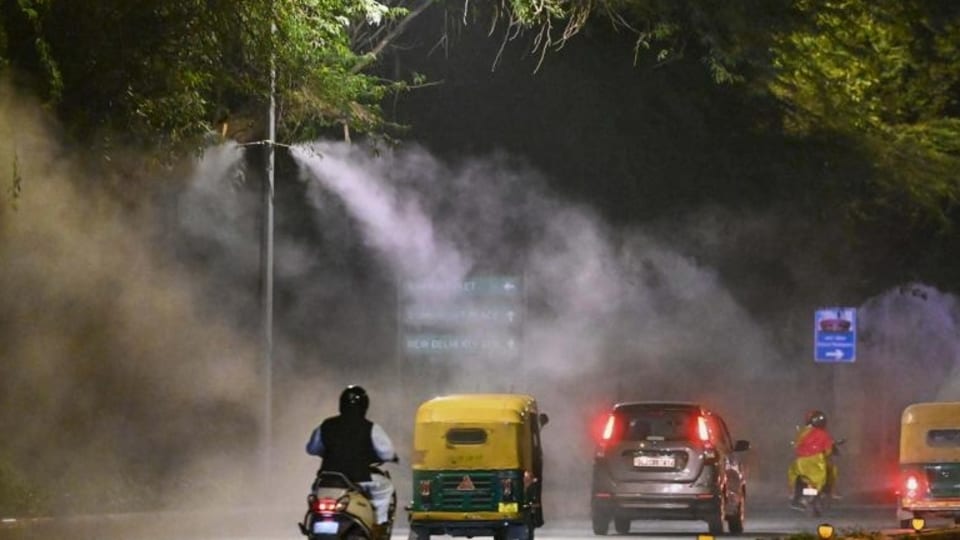
The CAQM said the decision was taken after observing a consistent decline in pollution levels across the national capital. The latest AQI reading marks a considerable improvement from the levels exceeding 400 that Delhi recorded in the aftermath of Diwali.
Announcing the withdrawal in a post on social media platform X, the CAQM said: "CAQM Sub-Committee on GRAP decides to revoke GRAP Stage III as daily AQI shows a downward trend, reaching 204 today. All actions under GRAP Stages I & II and restrictions as per the order dt. 30.10.2026, shall remain in force".
The decision brings some relief to residents and businesses in Delhi-NCR, where tighter pollution-control measures had been in place since November 6. However, the improvement in air quality does not mean that all restrictions have been lifted.
Measures under GRAP Stages I and II will continue to remain in force across the National Capital Region (NCR), along with the restrictions specified in the CAQM's order dated October 30, 2026.
The CAQM said its decision was based on the downward trend in Delhi's daily AQI. While the overall reading has improved, air quality across different parts of the capital continues to vary, with several monitoring stations still recording pollution levels in the ‘poor’ category.
Also Read | Delhi AQI sees marginal improvement for 2nd day, but stays in ‘poor’ category
‘Moderate air quality’
Of the 58 air quality monitoring stations in Delhi, 24 recorded ‘moderate’ air quality, while 31 reported ‘poor’ air quality. The Siri Fort monitoring station was the only one to register ‘very poor’ air quality, recording an AQI of 303 over the preceding 24 hours.
Despite the improvement in the overall AQI, the readings from individual monitoring stations indicate that pollution remains a concern in several parts of the capital. Delhi's average AQI of 204 also places the city in the ‘poor’ category, suggesting that air quality has not yet returned to satisfactory levels.
The difference in readings across monitoring stations highlights the varying pollution levels across the city. While a number of locations have recorded moderate air quality, several others continue to experience poor conditions. Siri Fort, meanwhile, remained the only station in the very poor category during the period.
Stage III restrictions under GRAP were first imposed on November 6, ahead of Diwali, after Delhi's average AQI climbed to 382. The reading placed the capital in the ‘very poor’ category, prompting the implementation of stricter pollution-control measures across the region.
The restrictions were introduced as pollution levels worsened in the run-up to the festival. With the AQI now showing a downward trend, the CAQM has decided to withdraw the additional curbs under Stage III. However, the continuation of Stages I and II means that measures to tackle air pollution will remain in effect across Delhi-NCR.


