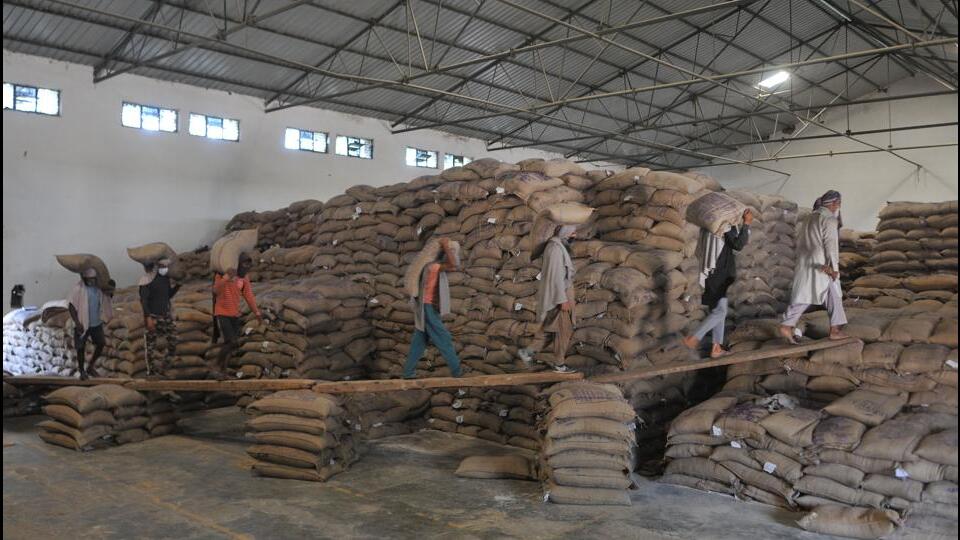
FCI rice supplied to ethanol distilleries increased from3.2 million tonnesin ESY 2024-25 to 4.4 milliontonnes in the current supply year (up to June 30).
Food Corporation of India (FCI) supplied a record 4.4 million tonnes of surplus Food Corporation of India (FCI) rice till June 30 for ethanol production in the current Ethanol Supply Year (ESY) 2025-26, which begins in November and ends in October, marking a sharp increase in the use of government grain after supplies resumed last year following a suspension over food security concerns.
The government has said that diversion of surplus FCI rice has had no impact on retail food inflation. (HT Photo)
The surge follows a new procurement condition introduced for the current ethanol supply year requiring grain-based distilleries bidding to supply ethanol to oil marketing companies (OMCs) to source at least 40% of their grain-based ethanol offer from surplus FCI rice during the first three quarters of the supply year. This was extended to the fourth quarter by a circular dated July 3 this year. The condition, incorporated in the oil marketing companies’ tender and reiterated during the pre-bid meeting, effectively made FCI rice mandatory for a substantial part of grain-based ethanol supplies.
To be sure, the government maintains that this increase does not affect food security in any way, a fact borne out by procurement data.
Parliamentary replies tabled on Wednesday show FCI rice supplied to ethanol distilleries increased from 3.2 million tonnes in ESY 2024-25 to 4.4 million tonnes in the current supply year (up to June 30). Four months of the current ethanol supply year (ESY) are still left. Maize use at 6.8 million tonnes is running below last year’s total of 13.1 million tonnes. At the same time, the use of damaged foodgrains and broken rice also fell to 99,000 tonnes from 1.79 million tonnes a year earlier. This indicates a shift in the grain mix towards FCI rice following the new procurement requirement.
The latest data mark a sharp reversal from 2023, when the Centre suspended FCI rice sales for ethanol after poor monsoon conditions linked to El Nino hit rice production and concerns grew over food security. Supplies resumed in ESY 2024-25 after rice stocks recovered and procurement improved.
Mandate changing grain mix
Industry executives said the new tender condition, coupled with comfortable government stocks, has been the biggest reason behind the jump in FCI rice use.
“Although distillers continue to prefer maize as the most profitable feedstock for ethanol production, the government’s mandate requiring at least 40% of grain-based ethanol to be sourced from FCI rice has ensured much higher use of rice in the biofuel basket,” said an industry executive, requesting anonymity.
A second parliamentary reply shows the Centre simultaneously expanded rice allocations for ethanol. It allocated 2.3 million tonnes of FCI rice in ESY 2023-24, although no rice was lifted because supplies had been suspended. Allocations increased to 5.2 million tonnes in ESY 2024-25, of which distilleries lifted 3.2 million tonnes, and have risen further to 7.2 million tonnes this year, with 4.4 million tonnes already lifted by June 30.
The renewed reliance on FCI rice has coincided with the rapid expansion of India’s ethanol blending programme. Average ethanol blending in petrol has steadily increased from about 10% in ESY 2021-22 to 20% now. According to recent data from the All India Distillers’ Association (AIDA), grain-based feedstocks now account for about 67% of ethanol supplied, compared with 33% from sugarcane-based feedstocks.
Why grains have overtaken sugarcane
The policy marks a significant departure from India’s original ethanol strategy, which relied largely on sugarcane.
“Companies producing both sugar and ethanol have to first take care of sugar production because both products come from the same feedstock. If sugar production is lower, sugar prices rise, making sugar production more remunerative,” said Abinash Verma, former director general of the Indian Sugar Mills Association (ISMA).
Under current production levels, sugarcane can contribute only about 3.5 billion litres of ethanol annually, he said.
“Cane is crushed for only about five months on average. That means ethanol availability from cane juice and molasses also becomes seasonal, and storage poses challenges. Sugarcane production is concentrated in Uttar Pradesh, Maharashtra and Karnataka, so relying solely on cane also increases transportation costs over longer distances. Grain-based distilleries, on the other hand, can operate throughout the year because rice and maize are easier to transport and store,” Verma said.
According to him, the government’s decision to diversify feedstocks was inevitable.
“The government realised ethanol from sugarcane alone could not take blending beyond 7-8% of the country’s requirement. At the same time, India had surplus grain stocks and maize was not finding enough industrial demand. That prompted the policy shift towards grain-based ethanol,” he said.
Verma said the latest tender condition has accelerated that transition.
According to the unnamed industry executive quoted above, the government’s mandate of grain-based distilleries having to source at least 40% of their grain-based ethanol offer from FCI rice pushed the mix further towards grain based ethanol.
Although maize often becomes cheaper than FCI rice during harvest seasons, making it commercially more attractive for distillers, the mandatory FCI rice component has ensured sustained government rice offtake, he said.
The ex-distillery price of ethanol from maize is ₹71.86 per litre, while ethanol from surplus Food Corporation of India (FCI) rice is priced lower at ₹60.32 per litre for the Ethanol Supply Year (ESY) 2025–26. However, blended petrol is sold at the same cost.
Grain mix shifts sharply
The parliamentary data capture how India’s grain ethanol programme has evolved over the past six supply years.
FCI rice supplied for ethanol rose from 0.05 million tonnes in ESY 2020-21 to 1.07 million tonnes in 2021-22 and 1.39 million tonnes in 2022-23 before dropping to zero after the 2023 suspension. It has since rebounded sharply to 3.2 million tonnes in ESY 2024-25 and a record 4.4 million tonnes this year.
Maize, meanwhile, emerged as the principal grain feedstock during the suspension period, increasing from 0.83 million tonnes in 2022-23 to 7.5 million tonnes in 2023-24 and peaking at 13.1 million tonnes last year before easing to 6.8 million tonnes in the current supply year as FCI rice returned to the ethanol basket.
Government says food security protected
The Centre has maintained that only surplus rice is diverted for ethanol after meeting obligations under the National Food Security Act (NFSA), other welfare schemes and prescribed buffer stock norms. In its parliamentary reply, it said diversion of surplus FCI rice has had no impact on retail food inflation and maintained that maize production, estimated at 55 million tonnes in 2025-26, is sufficient to meet demand from ethanol producers, poultry, cattle feed and other users.
The government’s confidence in releasing larger quantities of rice has coincided with rising procurement. Official data show rice procurement increased from 52.5 million tonnes in the 2023-24 marketing season to 55.3 million tonnes in 2024-25 and has already reached 56.2 million tonnes in the current season, providing a larger surplus after meeting food security commitments.
Pallavi Singhal covers agriculture, food policy and the rural economy from New Delhi. Over the past four years, she has reported extensively on farm policy, food inflation, procurement, agri-markets and rural livelihoods. Before joining Hindustan Times, she worked at Moneycontrol and Informist. A journalism post-graduate, she started as a trainee reporter in 2019 with The Indian Express, Chandigarh. Away from the newsroom, she enjoys travelling and crime fiction—preferably mysteries easier to crack than government policy.Read More
Get the latest India News, breaking headlines and real-time updates from across the country. Stay informed about politics, government policies, crime, weather and major national developments.
Home/India News/How FCI Rice Is Driving Govt’s Ethanol Push

 E-Paper