E-Paper



An exhibition with ambition that traces the untold history of comics in India


The comic format in India long precedes Pran Kumar’s popular creation, the genial walking stick-wielding Chacha Chaudhary and his alien side-kick, Sabu
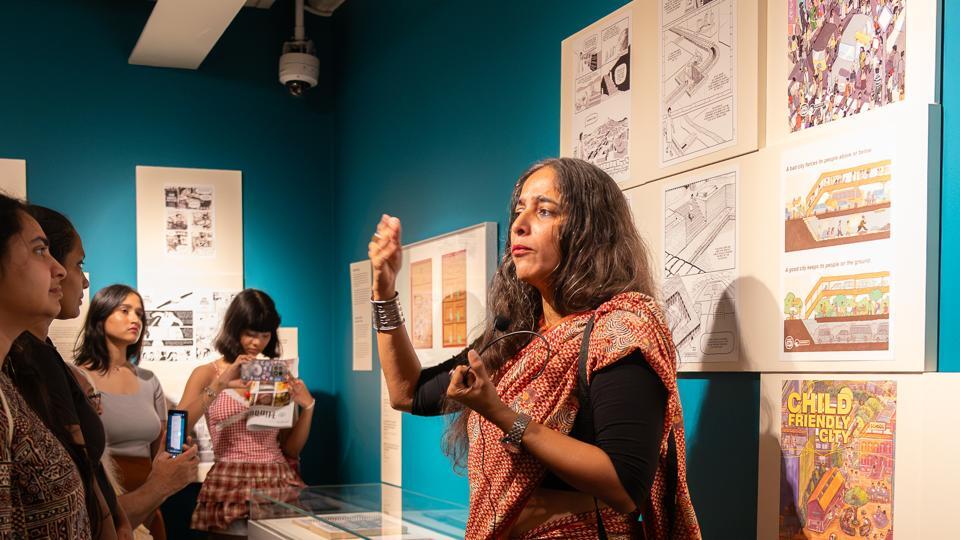
In a quiet leafy lane of Bengaluru, a little known history of India unfolded over a well-attended weekend in July. The Moving Line, curated by graphic novelist Amruta Patil, maps the genesis and evolution of sequential art — which includes comics — in the country. The exhibition, housed in the Museum of Art and Photography (MAP) is certainly an ambitious one, both in scale and narrative.
Patil’s collaborators included dedicated comics collectors and scholars in the country, the MAP team, and, thanks to the French Institute in India, the Cité Internationale de la Bande Dessinée (CIBD) based in Angoulême, a French city that has hosted a world-famous annual international comics festival since 1974. This exhibition is slated to travel to the festival early next year.
To understand what Patil, 47, has curated, one must first understand the improbability of it. While earnest, dedicated comic book collectors and pedagogues dot the country, there currently exists no pan-India repository of comics and graphic novels emerging from various regions. This, in turn, has created a gap in our knowledge.
By locating the comic in a continuum of visual storytelling in India that begins around 900 CE, with hero stones (also known as veeragallu, they depict scenes of a warrior’s valour) and relief work on temple friezes, winds its way through the living traditions of the likes of pattachitra (cloth scrolls from Odisha), kaavads (portable wooden shrines from Rajasthan) and shadow puppetry, and emerges in contemporary graphic novels, web-comics and AI generated sequential art, Patil offers us a hypothesis by studying the scattered evidence.
“The impulse to tell a story by merging a narrative track — whether oral or written — and a visual track, is a shared one across various forms of Indian visual storytelling. In the case of temple friezes, the bands of stories served as a reminder medium of lore that everyone knew, in the case of shadow puppets, kaavads and pattachitra, the story track was provided by an oral storyteller. Comics and graphic novels use many permutations and combinations of text. And then there are works that are read through visuals, and contain no text. So, I wanted to keep the curation broad — the one thing that unites all the works in the exhibition is that these are all stories told through a sequence of drawn images,” Patil, author of four graphic novels including Kari (2008) and Aranyaka (2019), said.
The exhibition, Moving Line, which will be on display till November-end, is divided into five sections: Timeless traditions, Early Indian comics, Popular comics, Feminist (r) evolutions, and Faultlines, Fine Lines. All the works on display challenge a well-held perception that the Indian comic book is derivative, meant for mass appeal, or synonymous with graphic novels.
“Far from being “fledgling” or “nascent” — terms I have been guilty of using to describe the Indian context — there has been a staggering amount of diverse and nuanced visual storytelling created in India over the century,” Patil said. “Comics and graphic novels in India have always been deeply political and invested in the state of our world. As early as 1915, the Tagore brothers set up The Bichitra Club, a salon for the arts whose fare addressed the caste system and hypocrisy of their own social milieu. Over a hundred years later, Samarth’s Suit (2022) and Siddhesh Gautam’s The Blue Book: An Anti-Caste Graphic Novel (2026) continue the caste-and hypocrisy-dismantling work,” Patil added.
***
Simply put, contrary to popular perception, the comic format in India long precedes Pran Kumar’s popular creation, the genial walking stick-wielding Chacha Chaudhary and his alien side-kick, Sabu, who first appeared in a Hindi comic strip in 1971. In fact, one of the first printed comic strips in India came out in a Bengali periodical called Basantak, 90 years before Phantom made his vernacular debut as Vetaal through Indrajal Comics in 1964, and at least six decades before the original English-speaking warrior of justice appeared in the Illustrated Weekly of India in the 1940s.
Basantak, first published in January 1874, was similar to Punch, the British satire magazine launched in 1841. Edited by Prananath Datta, an activist of the Municipal Movement in Calcutta, Basantak took its swadeshi roots seriously, but also poked fun at the satraps of society. The periodical regularly carried cartoons, and from the second volume onwards, comics too (the former distinguishable from the latter by the absence of sequential images often accompanied by speech bubbles or text). The topics ranged from the mismanagement of the city and arbitrary laws to social issues. The second volume carried a comic titled ‘Kirkwood Bilash Chittagong Plantain’ showing a tiff between two men — Lalchand Chowdhury and Captain Kirkwood — accompanied by text. The comic is unsigned.
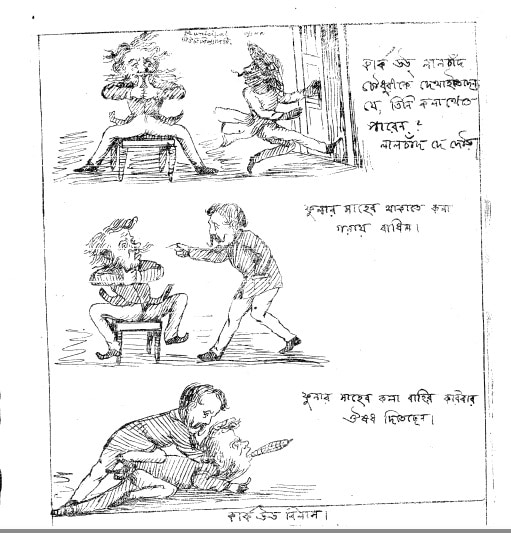
This comic became the point of departure for a group of five enthusiasts who call themselves the Comics Culture Collective (CCC). Formed during the pandemic, CCC members undertook extensive research into the history of Bengali comics. Pinaki De, a professor of English at Raja Peary Mohan College in Uttarpara, West Bengal, who is part of the group — Biswadeb Gangopadhyay, Debasis Gupta, Rituparno Basu, and Swagata Dutta Burman are the other four — made another interesting discovery: In the spring of 1921, Mouchak, a periodical, published a four-panel interaction between a worm and a baby duck titled Kemon Jobdo. The CCC archive also has pages from another periodical called Mukul, dating back to 1898, which show sequential narratives in panels, or illustrations with text — clearly, a sort of proto-comic narrative.
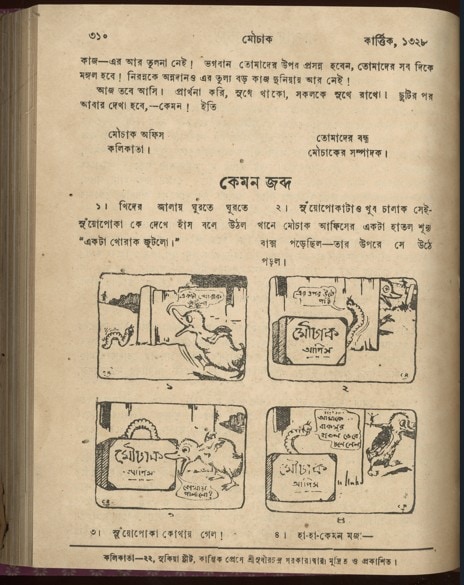
Could these be the country’s first set of comics?
Sukhalata Rao, a children’s story writer who contributed to Bengali periodicals, published some of the earliest comics with speech bubbles. In the autumn of 1921, her piece, Jemon Kormo Temon Fol (As you sow so shall you reap), was published in Sandesh — started by her father, Upendrakishore Ray Chowdhury. In it, a young boy hides behind a wall intent on throwing water on a man carrying a pot on his head. He ends up drenching a well-dressed man instead, who then proceeds to chase the child.
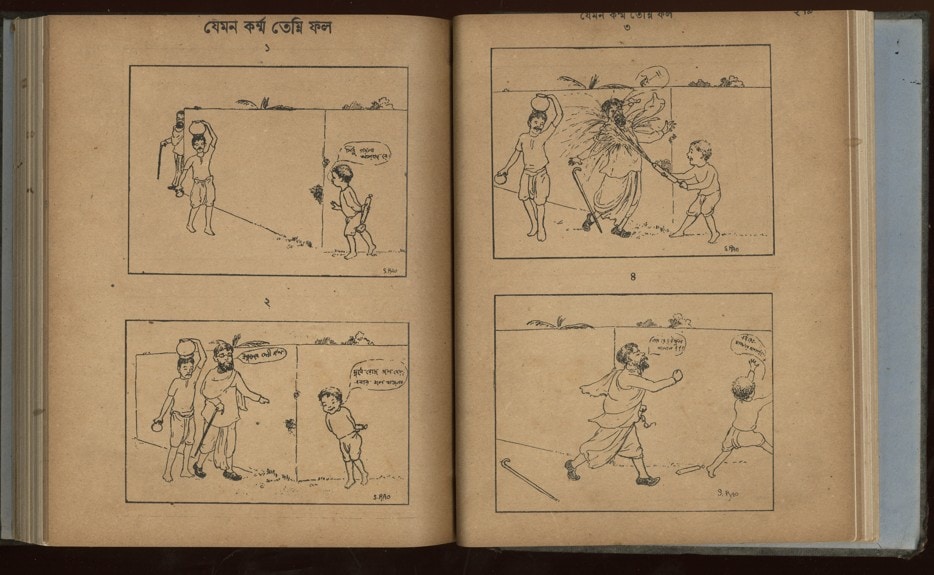
“We clearly had an ecosystem of comics, a sort of pictorial practice, at least in Bengali. The problem is that we haven’t been able to preserve them. Sandesh was well preserved, so we thought that comics with speech bubbles began in 1921, with Shukhalata Rao. However, the pages we have from Mukul and Mouchak tell us that maybe she was not the first to use text with comics,” De said.
“The CCC would like to build a digital archive that will help us delve into the visual and textual form of the comic. That’s one part of it. The other thing is that we don’t have a sense of the history of comics in India, which we would like to contribute to,” De said. The absence of both a comprehensive archive and a well-understood history of comics is deeply felt, and a handful have come forward to rectify it.
***
Together with a group of fellow students, De started a bilingual comics magazine (English and Bengali) titled Drighanchoo, while studying for a doctorate at Jadavpur University. The black and white magazine, named after a short story by Sukumar Ray, ran for three publications between 2009 and 2010. One of the members of that group — Deeptanil Ray — later joined a project started in 2014 under the aegis of the School of Cultural Texts and Records at Jadhavpur University. The Comic Book in India Project was helmed by professor Abhijit Gupta and its aim, as he told The Telegraph that year, was to collect and digitise comic strips in Indian languages “from its earliest days”. This included copies of Shuktara, a Bengali periodical, as well as comics by the little-known but now-well regarded comic artist, Mayukh Chowdhury, and comic strips made by Satyajit Ray (Sukumar Ray’s son, and Shukhalata Rao’s nephew).
Lack of manpower has meant that the project remains as yet unfinished, Gupta said.
Down south, one man’s efforts to piece together a history of comics began in the 1990s. As a child, Arun Prasad would read Phantom while waiting for his school bus in Eravankara, a village located in Kerala’s Mavelikara town. There were no western comics for Prasad growing up in a small village, but plenty of regional fare to consume. Bobanum Moliyum, created by V.T Thomas (aka Toms) was first published in Malayalam Manorama Weekly in 1957, and was a staple in many households. “I still think Bobanum Moliyum is one of the most underrated comics produced in India,” Prasad, now a Bengaluru resident, said.
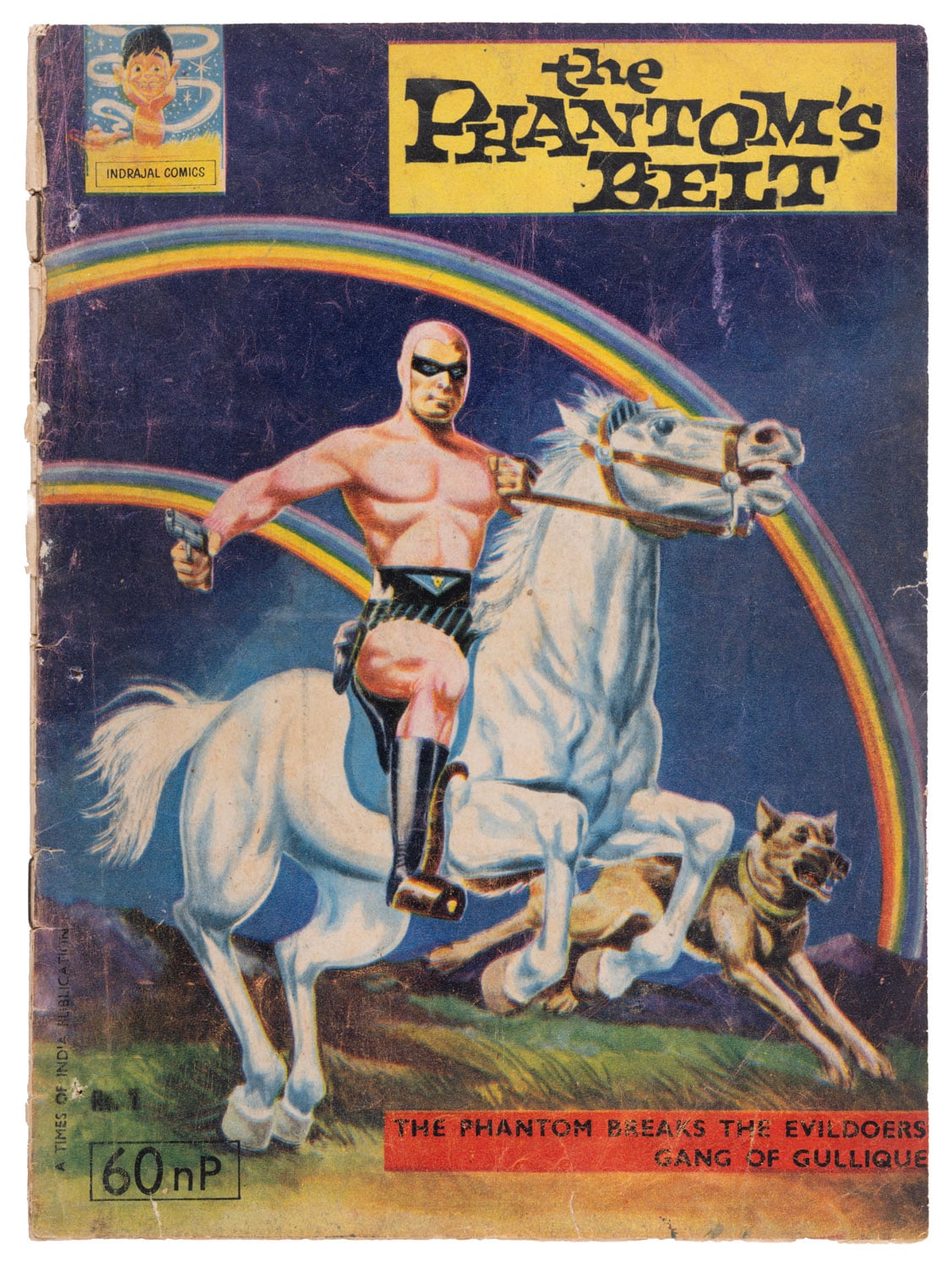
Prasad, now 51, possesses one of the largest individual collections of comics in the country — “give or take 40,000 pieces including comic books and cartoon strips in periodicals or magazines”— and says that the comics help him understand the politics, and socio-cultural mores of the era they’re from. “We think that Indian comics just copy Western ones, and blindly imbibe that culture. But in my perspective, Indian comics are deeper and richer,” Prasad said.
“So we know of Sandesh, the children’s magazine, in which Shukhalata Rao published her comics. Likewise, there are many comics that were published in Tamil magazines like Gandhi [a political, anti-British weekly started in 1931] which carried comics or cartoon strips on the cover page. In the 1940s, Times of India started a short-lived comics supplement called Junior Comics in 1949, which was mostly an anthology of western comics. Malayalam comics were also highly popular. There is G Aravindan’s Cheriya Manushyarum Valiya Lokavum (small people, big world), which was published in Mathrubhumi Weekly in the 1960s and 1970s.”
Material from Prasad’s collection are also part of the MAP exhibition. This includes comics with a mythological theme, which became highly popular starting from the 1950s — long before Anant Pai’s Amar Chitra Katha began publishing in 1970.
“In the early 1950s, a Delhi-based publishing house called Anantram and Sons began publishing comic books on subjects like historical figures and mythology. In 1953, the famous Geeta Press published the Bal Chitra Ramayan in Hindi. In 1956, Shishu Sahitya Samsad published comics for children called Chobite Ramayana and Chobite Mahabharat in Bengali. These experimental comic books ended up inspiring Anant Pai, who was the publisher of Amar Chitra Katha,” Prasad added. Indeed, LP records of Amar Chitra Katha stories being read out, which were sold in the 1970s — also from Prasad’s collection — are also part of the exhibition.
The thematic division of the exhibition also serves to underscore the need to understand history less as chronology, and more as ideas that achieve critical mass at different times.
For instance, in the section titled Feminist (R)evolutions, Patil forefronts who she calls “the OG irreverent female protagonist”, Manjula Padmanabhan’s comic character, Suki (who made her debut in the Sunday Observer in 1981 in the comic strip called Double Talk), and lists Priyanka Paul (a digital artist whose feminist, queer and anti-caste works are immensely recognised) and Indu Harikumar (best known for 100 Indian Tinder Tales illustrations) — both working in the 2010s and onwards — as “feminist heirs”.
The emergence of the Indian graphic novel in the 1990s, which saw the exploration of an India beyond exotica and religiosity, with a tempering down of patriotic fervour, saw the rise of auteurs like Sarnath Banerjee, Kruttika Susarla, Mia Jose, and Rohan Chakravarty, Patil said. “They all possess a self-assured, citizen du monde voice—both textually and visually—that speaks to a diffuse global audience without the need for cultural footnotes,” Patil added.
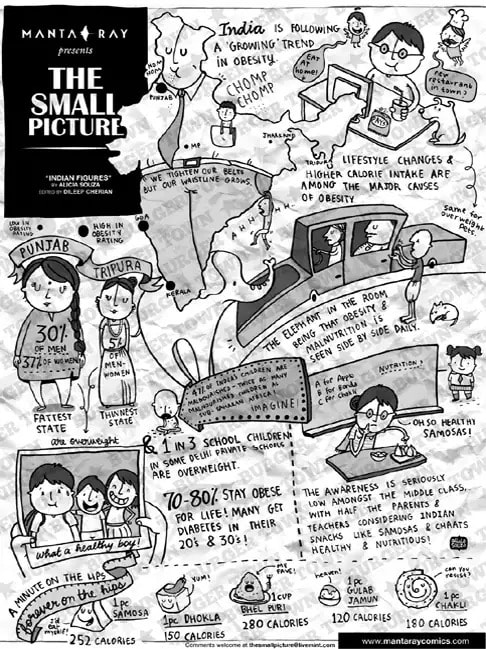
The curator, however, decided to tackle the medium slightly differently, by aggrandising the content within larger impulses of resistance in stories of land use, ecology, histories as well as a future written by AI models. The rise of digital and web comics also enabled the flowering of independent creators who were no longer beholden to the high costs of printing. More ambitious experiments also flourished around this time. In 2011, for instance, Mint, a business newspaper from the Hindustan Times stable, began to publish a weekly comic by Manta Ray, a Bengaluru-based independent publishing company. The idea, not replicated in any mainstream newspaper since, was to publish smart social and cultural opinions through the rich visual storytelling format popularised by the graphic novel.
***
Part of the learning, Patil said, while putting together this exhibition was recognising that the centres where comics were being produced and read remained largely region-specific, and cut off from each other.
“When it comes to the history of visual storytelling in India, it’s safe to say that the left hand hasn’t known what the right hand is up to,” said Patil.
“Awareness levels about our visual storytelling legacy, amidst lay people and academics alike, are not very high. One of the primary reasons is we simply do not write or read a common language! Multilingual publishing involves translation costs. Because of this even top-notch literature in the vernacular remains untranslated into other Indian languages; it remains regionally vital, but nationally unknown. For visual books, the small print runs mean even higher pricing, something that makes them untenable. A lot of indigenous comic content that emerged, say, in West Bengal, the Hindi belt or Kerala, was created for its context and culture, and did not seek readership crossover.”
Then, there was the trouble of locating original material to bring to the exhibition.
“I would have given anything to include artwork originals instead of digital prints of Yusuf Lien’s Mirabai (Amar Chitra Katha), but they are lost. This title, one of ACK’s best, marks an effortlessly syncretic moment of cultural production and social ease in India — a Tamilian Brahmin writer and a Muslim artist collaborating on an apex Bhakti story of sublime beauty. I grieve that this even needs to be remarked upon now,” Patil said.