DEATH. AND taxes. And the south-west monsoon. Had Benjamin Franklin, the most peripatetic of America’s founding fathers, ever ventured east of Europe he might have added India’s rainy season to his famous dyad of life’s certainties. For the 150-odd years that India has been collecting data the monsoon has hit the peninsula in early June, dumped roughly similar amounts of water over India and started retreating in late September.
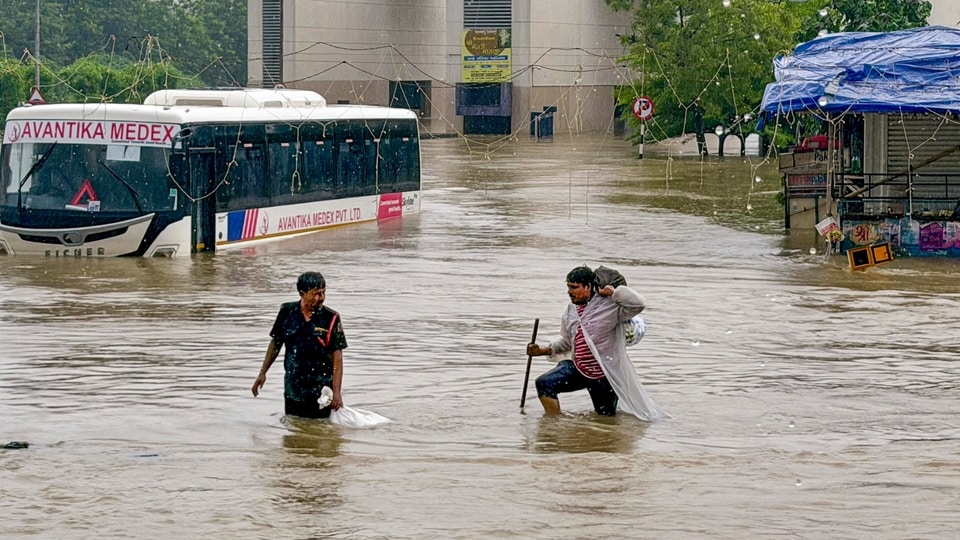
Ahmedabad: People wade through floodwater while a bus lies partially submerged following heavy monsoon rainfall, on the outskirts of Ahmedabad, Gujarat, Saturday, July 25, 2026. (PTI)
It did much the same thing before modern humans started measuring it, too. For centuries the rains have dependably watered the fields, offering mostly stable harvests to premodern societies. Ancient trade routes worked to its rhythms. The monsoon allowed Gujarati merchants on India’s west coast to sail out to Arabia and east Africa on the back of its winds and to return home when the pattern reversed.
In April India’s meteorological department issued its forecast for this year’s season. It predicted a weak monsoon at 92% of the “long-period average” of 1971-2020—below normal though not deficient. In the past that would have prompted hand-wringing about the effect on food production and prices of staples. But irrigation now covers more than half the country’s farm area, and a few points are not the make-or-break variation they used to be. It is instead how the season’s rainfall is distributed that keeps forecasters up at night. The monsoon is getting weirder.
Take Mumbai, where it usually starts raining around June 10th and begins to peter out in late September. Last year it rained from May until well into October. This monsoon it barely even drizzled until late June, followed by a whole July’s worth of rain in just the first week of the month. Gujarat, a dryish state, has been battered by heavy downpours in short periods, with parched spells in between. On the other side of the country, in the agrarian eastern state of Bihar, farmers have gazed up at clear skies. Farther east, in Assam, a state suffering a 30% rain deficit this season, 900 villages were submerged and at least 80 people were killed last month by some of the worst flooding in decades. This year may be especially unusual because of El Niño, a climate pattern that messes around with weather patterns. But the trend is well-established. Across India rain is coming harder and in shorter spurts.
The effects are felt most severely in agriculture, which employs 43% of India’s workers. Farmers plan their sowing on the basis of the approaching rains. Both flooding and extended breaks from rain play havoc with their crops. Urban areas are not immune. Compared with even just a decade ago, India is more built-up and its cities more populous, magnifying the economic and physical damage wrought by extreme weather. Water shortages are another concern. Long dry periods harden the soil and deplete the ground’s ability to soak in moisture and replenish its aquifers. Rain runs off into streams or simply evaporates.
The weirdening of the rainy season has a lot to do with climate change. The basic mechanics of the monsoon remain unchanged: the Indian land mass heats up in the scorching months of April and May, pulling in cooler, moisture-laden winds from the Indian Ocean. The ocean has been warming quite quickly as a result of global warming. The land, curiously, has not warmed as much. This dynamic means both that monsoon winds are slightly weaker—because the pressure difference between the land and sea is not as strong as it used to be—and that rains are fiercer, because warmer air holds more moisture. As Earth continues warming, the monsoon will become less predictable.
India cannot change the weather but it can handle it better. The meteorological department has built an impressive data-collection apparatus and is investing in improving the models that drive its forecasts. In June the government identified 111 poorly irrigated districts that might see rain shortfalls and took measures such as strengthening local water storage, boosting fodder supply and promoting hardier crops.
Yet regional and local variation in rainfall patterns means that there is only so much the national government can or indeed should do. States, cities and even villages need to plan for sudden heavy downpours, including through better irrigation and infrastructure. Meteorologists expect the monsoon’s fasting-feasting tendencies to grow only more acute. To death, taxes and the monsoon, add extreme variability, too.
Get the latest India News, breaking headlines and real-time updates from across the country. Stay informed about politics, government policies, crime, weather and major national developments.

 E-Paper